


Updated August 2026
A greenhouse can grow more than you'd expect, but the space goes faster than you'd think, which is why "what should I grow" is a harder question than it seems. The real questions are what needs the space, what grows better under cover than it would outside, and what you actually want to grow.
Some crops are transformed by growing under cover. Tomatoes and peppers, which sulk through a cool summer outdoors, get the sustained warmth they need to ripen properly. Greens that bolt the moment they get stressed stay tender for weeks longer. Other crops will grow perfectly well in a greenhouse and are still a poor use of the room, because they take up a great deal of space to give back very little you couldn't have grown outside.
Below we cover what to plant in your first season, how to get tomatoes right, the warm and cool season crops worth the room, what keeps producing through winter, how to use the space for seed starting, and what to leave outside. For timing in your specific zone, our beginner's guide breaks the whole year down by USDA zone.
What Grows Best in a Greenhouse?
The crops that benefit most are warm-season fruiting plants and cool-season greens. Tomatoes, peppers, cucumbers, and basil thrive in the sustained warmth of a greenhouse through spring and summer. Lettuce, spinach, kale, arugula, and mache grow through the cool months, and in Zone 6 and warmer they'll produce right through winter without added heat, using row cover on the coldest nights.
Here's how that breaks down.
| Crop | Season | Where it lives |
|---|---|---|
| Tomatoes | Warm season, spring through summer | Floor space, trained vertically toward the roof |
| Peppers and eggplant | Warm season, spring through summer | Floor space |
| Cucumbers | Warm season | Floor space, climbing vertical supports |
| Basil | Warm season, spring through summer | Shelves, in pots |
| Parsley, cilantro, chives, mint, oregano, thyme, rosemary | Most of the year in pots | Shelves and plant hooks |
| Lettuce, spinach, kale, arugula, chard, mache | Cool season, and through winter in Zone 6 and warmer | Shelves or floor beds |
| Strawberries | Warm season into fall | Shelves and hanging baskets |
| Seed trays | Late winter, ahead of the outdoor season | Shelves, on heat mats under grow lights |
Seed trays are the one row on that list that isn't a crop. In late winter, when the ground outside is frozen, a greenhouse gives you real light and steady warmth for trays that would otherwise be crowding a windowsill.

What to Grow in a Greenhouse for Beginners
If this is your first year, plant things that will show you results quickly. Confidence matters more than ambition in season one.
Lettuce and salad greens are the fastest reward in the greenhouse. Many varieties are ready to cut about a month after sowing; they tolerate cool temperatures, and cut-and-come-again types will regrow several times from the same planting.
Herbs are almost unfairly easy, and they live happily in small pots on shelves rather than taking floor space.
Tomatoes are the crop most people buy a greenhouse for, and they're worth the attention. They need more from you than greens do, which is why they get their own section below.
Cucumbers climb rather than sprawl when given something to grab, which suits a greenhouse well, and they produce heavily once they start.
Growing Tomatoes in a Greenhouse
Greenhouse tomatoes genuinely outperform outdoor ones in most climates. They get a longer season, consistent warmth, and shelter from the rain that spreads blight through outdoor plants. In a short-season area, a greenhouse is often the difference between ripe tomatoes and a bucket of green ones in October.
They also fail in a specific way indoors, and it catches almost everyone the first year.
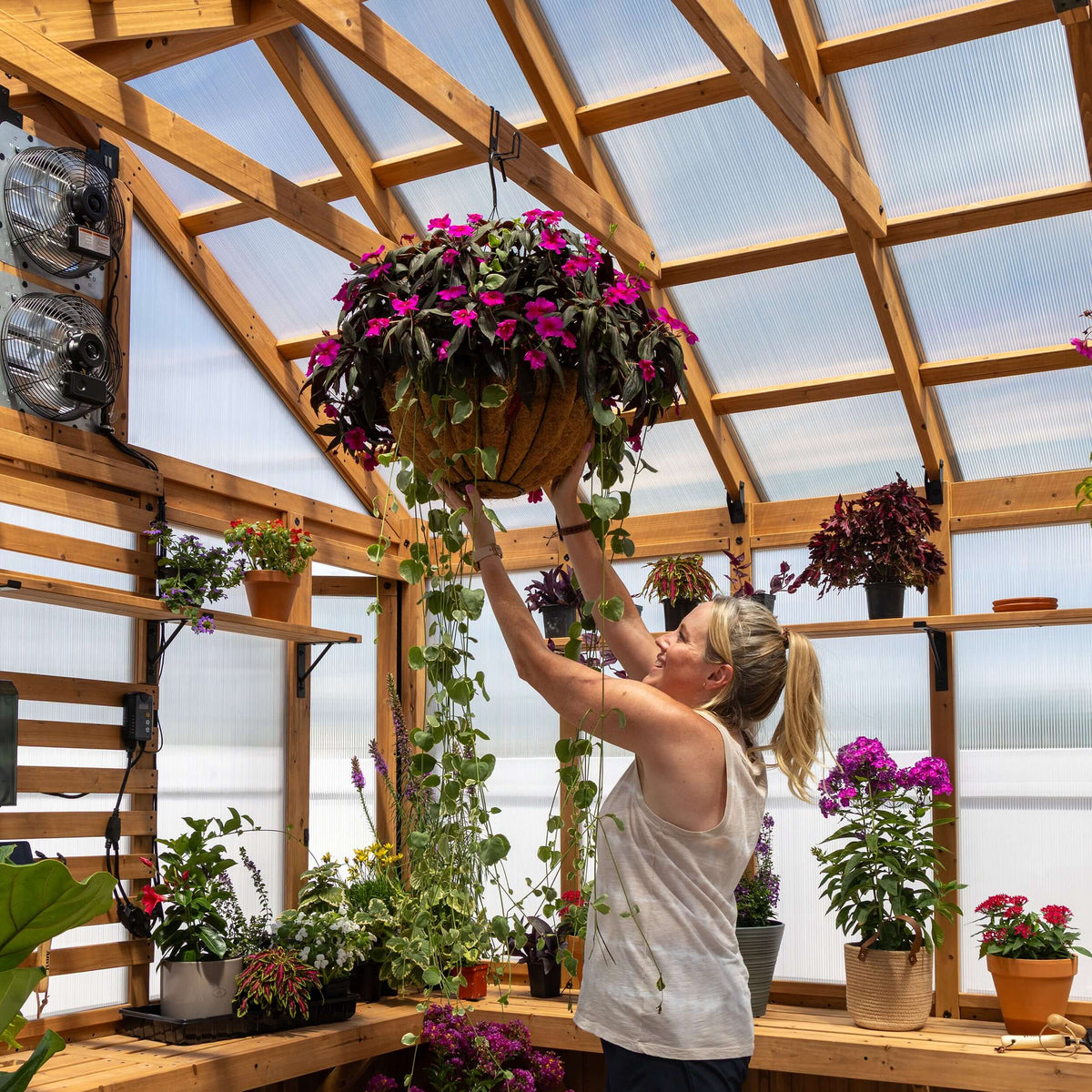
Pollination doesn't happen on its own. Tomato flowers are self-fertile, but the pollen has to be shaken loose to move from anther to stigma. Outdoors, wind and bumblebees do that constantly and invisibly. Inside a closed greenhouse there's neither, so you get healthy plants covered in flowers that drop without setting a single fruit. The fix takes seconds. Tap or gently shake each flower truss every day or two while plants are in bloom. A small circulation fan running at plant height does much of the same work continuously, which is worth setting up before flowering starts rather than after you notice flowers dropping. It's a separate job from your exhaust fan, and it's what the PowerPort™ Electric Hub inside every Backyard Discovery greenhouse is there for: three outlets and three USB ports, so a clip fan plugs in without an extension cord running through a door that then won't seal. Opening windows to let pollinators in handles the rest.
Sustained heat stops fruit from setting. Tomato pollen starts losing viability above roughly 95°F, and sustained heat past 104°F can halt fruit set almost entirely, so a greenhouse that runs hot through midday in July will drop flowers even though the plants look thriving. This is the most common reason greenhouse tomatoes underperform in summer, and it's entirely a ventilation problem. A closed greenhouse can reach 100°F on a mild spring day, which is why a thermostat-activated exhaust fan matters more for tomatoes than for almost anything else you'll grow. Our ventilation guide covers airflow and shade cloth in detail.
Humidity works against you twice. Very damp air makes pollen clump instead of falling freely, and it invites leaf mold and botrytis, both of which are far more common under cover than outdoors. Watering in the morning rather than the evening, so foliage dries before nightfall, prevents most of it.
Grow up, not out. Indeterminate varieties keep growing and fruiting all season, and a greenhouse is one of the few places you can really use that. Train a single stem up a string or stake toward the roof, pinch out the side shoots, and one plant will occupy about a square foot of floor while producing for months. Determinate varieties are the better choice if you want a concentrated harvest for canning.
Water consistently. There's no rain inside a greenhouse, so every drop is your decision. Irregular watering is the usual cause of blossom end rot and split skins, and both are more about consistency than about any deficiency.
Late in the season, as light drops, ripening slows. Removing the growing tip in late summer pushes the plant to finish what it has already set rather than starting fruit that will never mature.
Warm-Season Crops
Peppers want the same conditions as tomatoes and are, if anything, better suited to a greenhouse, since they love heat and resent cool nights. They need the same pollination help.
Cucumbers are heavy producers under cover. Give them vertical support and they'll use the height rather than sprawling across your floor. Some greenhouse varieties are parthenocarpic, meaning they set fruit without pollination at all, which sidesteps the issue entirely.
Eggplant thrives in greenhouse warmth and is often disappointing outdoors in cooler regions, which makes it one of the more satisfying crops to move under cover.
Basil is a natural companion to all of the above and appreciates exactly the same conditions.
What to Grow in a Greenhouse in Winter
This is where a greenhouse quietly earns its keep, because it extends your season at the end nobody plans for.
Leafy greens are the core of it. Lettuce, spinach, kale, arugula, chard, and mache all prefer cool conditions and will keep producing well past the point where outdoor beds have given up. Sow them in late summer or early fall for harvest through the cold months.
Root crops work well too. Carrots, beets, and radishes appreciate the frost protection, and radishes in particular are fast enough to fit into gaps between other plantings.
Brassicas like broccoli, cabbage, and Brussels sprouts grow well in the cool season, though they need more space and more patience than greens.
Glazing decides how far you can push all of this. An unheated greenhouse settles close to the outside temperature overnight, so the panel is what determines your margin on a hard night: single-pane glass sits at R~0.9, standard 6mm twin-wall polycarbonate at R~1.6, and the 10mm 4-wall polycarbonate we use across every model at R~2.1, holding roughly 30 percent more heat than twin-wall.
Where you garden decides the rest. Row cover — a lightweight, breathable fabric draped directly over the plants to trap warmth — buys you a few more degrees on the coldest nights, and how hard you lean on it comes down to your zone.
| USDA Zone | What winter growing looks like |
|---|---|
| Zones 3 through 5 | Hardy greens will carry with row cover, but anything beyond the toughest varieties will need supplemental heat |
| Zones 6 and 7 | Cold-hardy greens will produce through winter in an unheated greenhouse, with row cover on the coldest nights |
| Zones 8 through 10 | Mild winters allow extended production with minimal frost protection; the harder problem becomes summer heat rather than winter cold |

Growing Herbs in a Greenhouse
Herbs may be the best value per square foot in a greenhouse, because they need so little of it. Parsley, cilantro, chives, mint, oregano, thyme, and rosemary all do well, and most will carry on far later into the year than they would outside.
Their real advantage is that they live in small pots, which means they belong on shelving rather than on the floor. Every Backyard Discovery greenhouse includes staging shelves and a slat wall that organizes tools, hooks, and planters vertically, and most models add four to eight movable plant hooks for hanging baskets or drying bunches. A greenhouse with that kind of vertical infrastructure holds a substantial herb collection without giving up any of the floor space your tomatoes need. Check our how to start an herb garden guide for more.
Growing Fruit and Citrus in a Greenhouse
Strawberries are the easy win. They do well in containers, appreciate the protection, and can be grown on shelves or in hanging baskets where they take no floor space at all.
Figs are genuinely well suited to a greenhouse in cooler regions, where they often struggle to ripen outdoors.
Citrus is rewarding, and it isn't a beginner project. Lemons, limes, and oranges need protection from freezing through winter, which in most of the country means supplemental heat rather than glazing alone. They also take several years to produce meaningfully from a young tree. One practical note if you're moving potted trees in and out seasonally: every model of ours has a door wider than a standard greenhouse door and sized for a wheelbarrow, which is what a mature potted citrus actually requires. If you're in Zone 8 or warmer, or you're prepared to heat through winter, citrus is a genuine pleasure. If you're in Zone 5 and hoping the greenhouse alone will carry a lemon tree through January, it won't.
Starting Seeds in a Greenhouse
The single highest-value thing a greenhouse does in late winter is let you start plants from seed at real scale.
A packet of seeds gives you access to varieties no garden center within an hour of you will carry, and it costs a fraction of what buying starts costs. What a greenhouse adds is light and consistent warmth, which is what windowsill seedlings are always short of, and which is why they end up leggy and weak.
Cool-season crops go in first, on heat mats, several weeks before warm-season ones. Warm-season seeds follow, then get hardened off before transplanting.
Seed starting is the one stretch of the year a greenhouse genuinely needs to be plugged in. Heat mats go under the trays, a grow light goes over them through the short days of late winter, and often both are running at once. The PowerPort™ Electric Hub puts three outlets and three USB ports inside the structure, so all of that draws power from where the trays actually sit. Exact timing varies enormously by zone, which the planting calendar in our beginner's guide handles.
What Not to Grow in a Greenhouse
Not everything belongs under cover, and knowing what to leave outside is part of using the space well.
Corn needs wind for pollination and takes a great deal of room for a modest return. Potatoes grow perfectly well in a greenhouse and would grow just as well in a bag outdoors. Pumpkins, winter squash, and melons sprawl aggressively for a harvest you could get from a corner of the garden. If you have a large greenhouse and want to try them anyway, train them vertically and support the fruit.
The general test is size against necessity. If a crop grows happily outdoors in your climate without protection, and it's large, it's usually the wrong use of greenhouse space. Save the room for the things that genuinely need warmth, shelter, or a longer season.
Matching Crops to Your Greenhouse
What you plan to grow changes which measurement matters, and it's worth knowing which one before you shop.
Herbs, greens, and seed trays are small-pot crops that live on shelves, so what you need is linear feet of staging rather than floor area. Our compact Willow carries 13 linear feet; the Poppy fits 26 into the same 9x6 footprint by adding a freestanding 4-tier rack.
Tomatoes, peppers, and trained cucumbers need floor space and headroom, but heat is the binding constraint, not room. Ventilation has to scale with the volume it's cooling, which is why the largest models in our lineup — the Savannah and the Larkspur — carry two thermostat-activated exhaust fans rather than one. That's what keeps a July greenhouse below the temperature where flowers stop setting fruit.
Winter greens and overwintered tender plants come down to the panel. The panel is what gives cold-hardy crops their margin on a hard night, which is why every model is glazed in 10mm 4-wall at R~2.1 rather than the standard R~1.6 twin-wall.
Sizing a greenhouse against all of this at once is its own decision, and our buying guide walks through it model by model.
Browse all Backyard Discovery greenhouses
What to Grow in a Greenhouse: Frequently Asked Questions
What grows best in a greenhouse?
Tomatoes, peppers, cucumbers, eggplant, and basil benefit most in the warm season, since they need sustained warmth that outdoor conditions often can't provide. Lettuce, spinach, kale, arugula, and mache are the best cool-season crops and will produce well past the first frost. Herbs and strawberries are excellent choices because they grow in small pots on shelves rather than using floor space.
What can I grow in a greenhouse in winter?
Cold-hardy greens are the mainstay, including kale, spinach, mache, arugula, and hardy lettuce varieties. Root crops like carrots, beets, and radishes also do well. In Zone 6 and warmer, these will produce through winter in an unheated greenhouse, using row cover on the coldest nights. In Zones 3 through 5, expect to need supplemental heat for anything beyond the hardiest greens.
Why are my greenhouse tomatoes flowering but not fruiting?
Almost always pollination or heat. Tomato flowers need vibration to release pollen, and a closed greenhouse has neither wind nor bees to provide it, so tap or shake the flower trusses every day or two while plants are blooming. If it's midsummer, heat is the more likely cause, since sustained temperatures past 104°F can halt fruit set almost entirely. Better ventilation solves it.
What can you grow in an unheated greenhouse?
Far more than most people expect. Through spring, summer, and fall an unheated greenhouse handles the full range of warm and cool season crops. Through winter it will carry cold-hardy greens and root crops in Zone 6 and warmer. What it won't do without heat is keep tender or tropical plants alive through a hard freeze in a cold zone, since an unheated greenhouse settles close to outside temperatures overnight.
What should you not grow in a greenhouse?
Corn, potatoes, pumpkins, and winter squash are usually poor uses of the space. They're large, they grow well enough outdoors in most climates, and corn additionally needs wind for pollination. Greenhouse space is best given to crops that need warmth, shelter, or a longer season than your climate provides.

Leave a comment
This site is protected by hCaptcha and the hCaptcha Privacy Policy and Terms of Service apply.