


Updated August 2026
Outdoor gardening is a negotiation with the weather. Greenhouse gardening isn't. Heat, water, air, and light stop being things that happen to you and start being things you decide, which is the whole appeal and also the part that trips people up. Nothing is handled for you anymore.
This guide assumes you already know roughly what your targets are. It's about how you actually hit them, week to week, without living in the greenhouse. If you're still setting up your first season, our beginners guide covers site selection, temperature targets, and the planting calendar first.
Below we cover holding temperature through the day, three watering habits worth keeping, managing humidity and airflow, the pests that show up most in greenhouses and how to tell them apart, how light changes what's possible through the year, the cleaning jobs that actually matter, and what to check each season.
Greenhouse Gardening Tips at a Glance
Aim for 65 to 85°F during the day, with warm-season crops happiest at the upper end and holding above 55°F at night. Vent before the temperature spikes rather than after. Water in the morning, deeply and less often. Turn leaves over weekly, and check the soil surface too, since most greenhouse pests show up in one place or the other before any damage is visible from above. And expect growth to slow in late fall regardless of temperature, because short days limit growth too, which is why some growers add supplemental lighting.
How to Control Temperature in a Greenhouse
Knowing the target range is the easy part. Hitting it on a day that starts at 45°F and reaches 70°F by mid-afternoon is the actual skill.
Vent before the spike, not after. A greenhouse gains heat faster than it sheds it, and by the time the interior feels too warm, you're already behind. A closed greenhouse on a sunny 60°F spring day can reach 100°F or higher by noon, and even a well-ventilated one runs 20 to 30°F above outside air. If you're venting manually, open up when the sun hits the glazing, not when the thermometer alarms.
Let the thermostat do the timing. Manual venting depends on you being there at the moment the sun hits the glazing, which on a spring morning is often eight o'clock on a workday. A thermostat-activated fan removes that dependency. Set your target and stop thinking about it.
Thermal mass flattens the curve. Water, stone, and soil absorb heat during the day and give it back after dark. The same mass that holds warmth overnight also blunts the afternoon spike on the way up, so it works in both directions. A few water containers along the back wall do real work.
Watch the extremes, not the average. A greenhouse that averages a comfortable temperature can still have spent the afternoon well above the top of your target range. Min/max readings tell you what actually happened while you were at work, which is what your plants responded to.
In high summer, shade becomes part of temperature management alongside ventilation, and our ventilation guide covers shade cloth and airflow in detail.
Once outside temperatures drop below freezing overnight, holding a target range stops being a ventilation question and becomes a heating one.

Three Watering Habits Worth Keeping
Three habits handle most of it. Water in the morning so foliage dries before nightfall. Water deeply and less often rather than a little every day. UConn Extension puts it plainly: light waterings encourage poor, shallow root growth, while a thorough soak moistens the whole root system. And check the soil rather than the calendar, because container size and material change how fast things dry out far more than plant size does. Seed trays are the exception to all of this. They hold almost no reserve and want consistent moisture rather than a soak-and-dry cycle, so check them daily through spring and treat them separately from your pots.
If daily hand-watering is becoming the job rather than the pleasure, an automated setup is worth the afternoon it takes to install.
Humidity and Airflow
Damp, still air is the condition greenhouse fungal disease needs. Powdery mildew, botrytis, and leaf mold all establish in stagnant conditions where moisture sits on leaf surfaces, and a greenhouse removes the wind and the drying that would otherwise interrupt them.
Airflow is the answer more often than any spray. Space plants so air moves between them rather than filling every inch of shelf, which is where having enough staging matters more than it sounds. Keep a circulation fan running at plant level. It prevents the dead air pockets where humidity and fungal spores collect, and it does a second job most owners never think to ask of it: tomatoes and peppers need physical agitation to release pollen, so if yours are flowering but not setting fruit, insufficient air movement is the most likely cause. Vent on damp days even when the temperature doesn't demand it, because you're exhausting moisture, not heat.
Put a number on it. Humidity is easier to ignore than heat, and a hygrometer is what stops you ignoring it. Our ventilation guide carries the full humidity scale, what to do at each level, and the morning condensation check that tells you how the night went.
There's a second reason to keep exchanging air that has nothing to do with moisture. Plants in a sealed greenhouse can deplete CO2 to levels that slow or stop photosynthesis within a few hours, and outside air is the only thing that replenishes it. A greenhouse closed up all day is limiting growth even when the temperature and humidity both look fine.
Common Greenhouse Pests and How to Control Them
This is where greenhouse growing diverges most sharply from outdoor growing, and it's worth understanding properly rather than reacting to.
Outdoors, pest populations are held down by wind, driving rain, temperature swings, and a standing army of predators. A greenhouse removes all four. What you have instead is stable warmth, still air, and no natural enemies unless you invite them, which is close to ideal conditions for a small number of specific pests.
The ones you'll meet most are aphids, whitefly, thrips, spider mites, and fungus gnats. Learning to tell them apart matters, because the treatment differs and two of them are caused by opposite conditions.
Aphids are small, soft-bodied, and cluster on new growth and the undersides of leaves. The New England Vegetable Management Guide describes the greenhouse pattern: they are usually females producing live young without mating, 50 or more each, with those nymphs reproducing themselves in as little as 7 to 10 days. That is how a few become hundreds. The first sign is often not the insect but the sticky honeydew they leave, which then grows black sooty mold. A firm spray of water knocks populations back, insecticidal soap handles the rest, and both work far better early.
Whitefly are tiny and white and rise in a small cloud when you disturb a plant. Like aphids they feed on sap and leave honeydew. Yellow sticky traps are genuinely effective against the adults, which makes them a monitoring tool as much as a control. The catch is that eggs and nymphs sit on leaf undersides untouched by traps, which is why UMass Extension pairs card counts with inspecting undersides rather than relying on either alone. Anything you do needs repeating over a couple of weeks to catch the next generation.
Thrips are slender and barely a couple of millimeters long, and you usually see the damage before the insect: silvery streaking or stippling on leaves, sometimes with tiny black specks of frass. They feed by rasping the leaf surface, and they favor flowers and new growth. Blue or yellow sticky traps catch adults and tell you whether numbers are rising.
Spider mites are the one people miss longest, because they're nearly too small to see. What you notice first is fine stippling on leaves, a bronzed or dusty look, and eventually delicate webbing at leaf joints. Critically, spider mites thrive in hot, dry conditions, which is the opposite of most greenhouse problems. University of Missouri Extension puts their preferred range at 80°F or above with relative humidity under 50 percent. If you have them, the greenhouse has been running hot and dry, and raising humidity works against them.
Fungus gnats are small dark flies that drift around the soil surface. The adults are harmless, but the larvae live in wet soil and feed on roots and organic matter, which stunts seedlings. They're almost always a watering problem rather than a pest problem. UC IPM notes the damage is worst in propagation areas and seedling flats, and that root feeding can wilt a plant that is being watered perfectly well. Letting the soil surface dry between waterings removes the habitat, sticky traps catch adults, and for a persistent infestation, biological controls like Steinernema feltiae nematodes or Stratiolaelaps predatory mites treat the larvae in the soil.
Notice the pattern. Spider mites signal hot and dry. Fungus gnats signal wet. The conditions you keep decide which of those two you end up with, which means a good deal of pest management happens before you ever see a pest.
A weekly habit worth ten minutes
Turn leaves over and look. You now know what you are looking for: aphids clustered on new growth, whitefly lifting in a cloud when you move the plant, silvery stippling for thrips, fine webbing at the leaf joints for mites. By the time any of it shows from above you are several generations in.
Watch the soil surface, not only the leaves. Fungus gnats are the one pest here that never appears on the undersides, and drifting adults are the only visible sign you get before seedlings start to stall.
Hang a few yellow sticky traps before you have a problem. UMass uses yellow for general monitoring and notes that blue may be more attractive to thrips. Cards catch fliers, so whitefly, thrips, fungus gnats, and winged aphids land on them, which makes a filling trap an early warning rather than a treatment. Spider mites and wingless aphids never fly and will never show up, so the cards supplement the leaf check rather than replacing it.
Quarantine anything new. A plant from a garden center, or one that summered outdoors and is coming in for winter, is how pests usually arrive in the first place. A week apart from everything else costs nothing.
Act on trends, not sightings
Finding three aphids is not an emergency, and treating every insect on sight is neither practical nor good for the ecosystem you actually want. What matters is direction. A population that's larger this week than last week needs intervention; a handful that stays a handful is being controlled by something already.
That's also worth weighing when you decide how much to open up. Bees and other pollinators are welcome visitors, particularly if you're growing cucumbers, squash, or melons that depend on insect pollination rather than the light agitation that sets tomatoes and peppers. Aphids, whitefly, and thrips are a different story, which is why the Larkspur's magnetic window screens lift on and off by hand: open while your cucurbits are flowering, screened during an aphid bloom.

How Light Changes Through the Year
Temperature gets all the attention, and light is the variable that quietly decides what's possible.
Two things happen as fall progresses. Days get shorter, and the sun sits lower, so the light that does arrive passes through more atmosphere and strikes the glazing at a sharper angle. The result is a steeper drop in usable light than the shorter day length alone suggests.
Below roughly ten hours of daylight, most plants slow dramatically. UC Master Gardeners put the threshold where most plants need at least ten hours of daylight for active growth, a stretch growers call the Persephone period, after the term coined by Eliot Coleman. Growth doesn't stop, but it nearly pauses, and this catches people who assume warmth is the only requirement. It's the reason heating a greenhouse through December doesn't produce December tomatoes. Winter growing works because cold-hardy greens are being held and harvested through the dark months rather than actively grown. WSU Extension Master Gardeners are explicit about leafy greens: they can be harvested right through the period, but they will not regrow until the days pass ten hours again. Supplemental lighting can close the gap, but fruiting crops need far more light than greens do, so the equipment and running hours are a different proposition from adding a heater.
Knowing that changes how you plan. Without lights, crops intended for winter harvest need to reach nearly full size before the light collapses, which is why the planting calendar puts cool-season sowings in early to mid fall rather than in winter itself.
Glazing cleanliness matters more in winter than summer. Dust, algae, and grime reduce light transmission year-round, but in June there's surplus light and in December there's none to spare. A wash of the panels going into fall is one of the highest-return jobs on the list.
Rotate plants. Light is uneven in any greenhouse, and plants lean toward it. A quarter turn when you water keeps growth even, and moving trays between shelves shares the best positions around.
How to Clean a Greenhouse
A handful of jobs pay for themselves in plant health rather than appearance.
Clean the panels once a year with mild soap and water. Never use abrasive cleaners or solvents, which can damage the UV coating. If you wash only once, do it going into fall. This is a light-transmission job rather than a cosmetic one, and winter is when the light is worth most.
Clear debris from corners and under benches, where fallen leaves and old mix shelter pests and fungal spores between seasons.
Do a genuine end-of-season cleanout. Remove spent plants, empty and wash pots and trays, and sweep the floor. Pest and disease problems carry from one season to the next in the material left behind, so anything overwintering in a corner is waiting for spring. This single job resets the cycle.
What to Check Each Season
| Temperature | Water | Pests and plant health | Structure | |
|---|---|---|---|---|
| Spring | Vent early on bright days; check the fan runs before the first warm spell | Increase frequency as growth accelerates | Inspect weekly as populations wake up; quarantine new plants | Check seals, hinges, and fasteners after winter |
| Summer | Peak ventilation; watch min/max, not averages; add shade if needed | Daily checks; morning watering essential | Peak pest season; spider mites if running hot and dry | Keep vents and fan intakes clear |
| Fall | Step ventilation down gradually as nights cool | Reduce frequency as growth slows | End-of-season cleanout; remove spent plants | Wash panels for winter light |
| Winter | Watch for overheating on bright days even in cold weather | Water sparingly; wet soil in cold weather invites problems | Watch for fungus gnats in cold, wet soil | Keep vents and fan intakes clear of ice |
How Your Greenhouse Makes This Easier
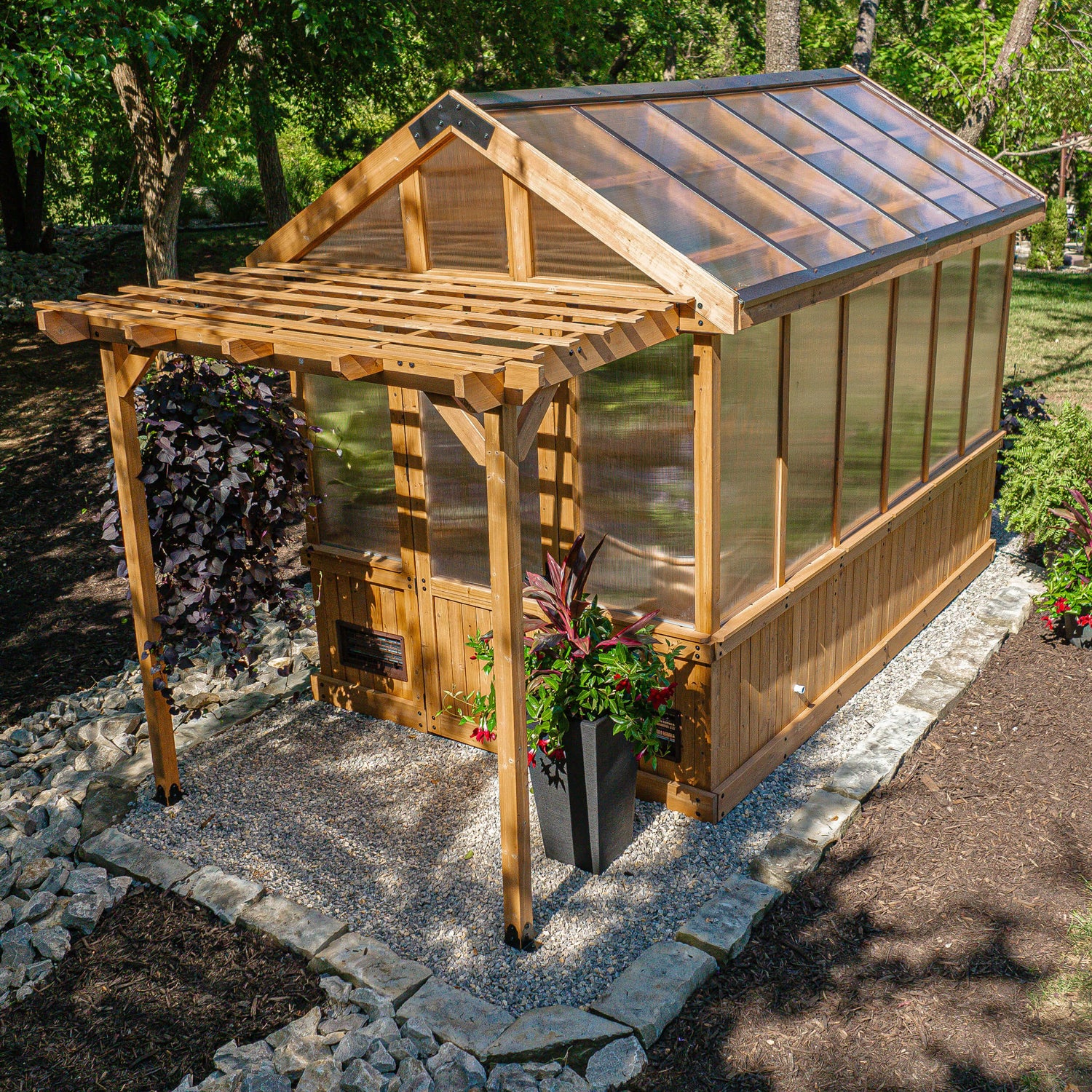
Most of the work above is a response to a problem the structure created. A better structure creates fewer of them. Everything in this section is standard on every Backyard Discovery greenhouse, not an upgrade.
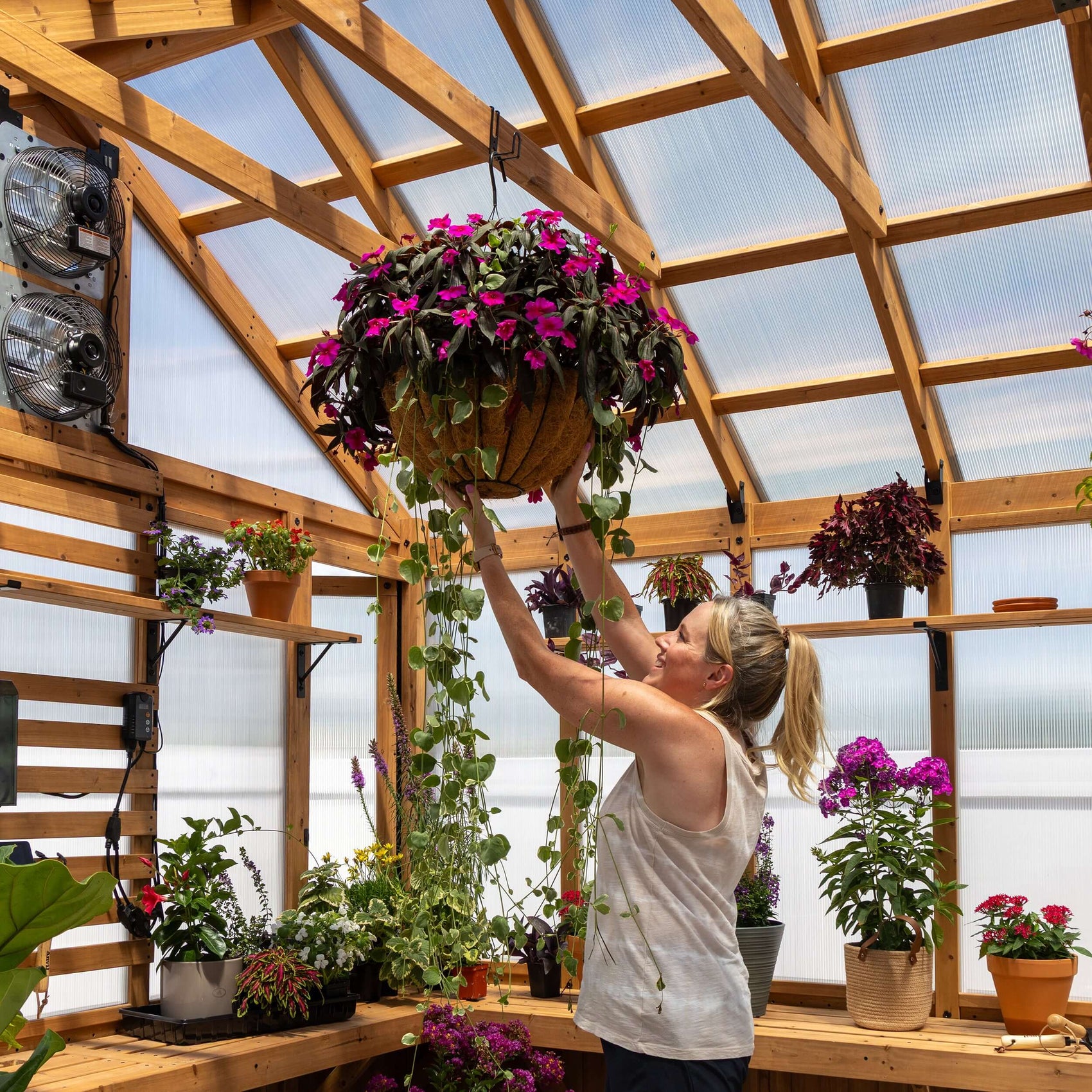
A thermostat-activated exhaust fan handles the timing problem that manual venting can't. It comes on at your setpoint and cycles off when the air cools, which means the greenhouse is managed in the middle of the afternoon whether or not you're home. Every model includes at least one as standard, and the Savannah and Larkspur each include two.
Opening windows and low intake vents are what you use when you would rather do it by hand. Our greenhouses have both: one to four windows depending on size, and one or two intake vents set low on the opposite wall. Cool air comes in low, warm air leaves high, and none of it needs power. That is the cross-flow the airflow section above depends on.
The PowerPort™ Electric Hub puts three outlets and three USB ports inside the structure. A heat mat, a circulation fan, a Wi-Fi thermometer, grow lights: all low-draw, all things you end up wanting, and none of them worth running an extension cord through a door that then won't seal. Supplemental heaters are the exception and want a dedicated circuit, per the manual and your local electrical code.
An interior spigot removes the friction from daily watering. Watering happens properly when it's easy and may get skipped when it means hauling a can across the yard in July.
Staging shelves and a slat wall are what let you space plants for airflow instead of crowding them, which is disease prevention that costs nothing extra. Our models carry from 13 linear feet of staging in the Willow up to 55 in the Savannah, included rather than sold separately.
10mm 4-wall polycarbonate rated at R~2.1 holds roughly 30 percent more heat than the standard 6mm twin-wall at R~1.6 used on most consumer greenhouses, which widens the range of nights you can simply leave alone. It also diffuses light more evenly than twin-wall or glass, which means fewer hot spots across your shelves.
Browse all Backyard Discovery greenhouses
Greenhouse Gardening Tips: Frequently Asked Questions
When should I open and close my greenhouse?
Open when the sun hits the glazing, not when the interior already feels warm. A greenhouse gains heat faster than it sheds it, so by the time you notice, you're behind. On a spring morning that can mean eight o'clock, which is why a thermostat-activated fan is worth more than good intentions. Close gradually as the sun comes off the structure in late afternoon so the interior isn't dumping heat into a cold evening. On damp days, vent anyway even if the temperature doesn't call for it, because you're exhausting moisture rather than heat.
How often should you water plants in a greenhouse?
Check the soil rather than following a schedule. Container size and material affect drying speed more than plant size does, so a small terracotta pot may need water daily while a large plastic one goes several days. Water deeply and less often rather than lightly and daily, and water in the morning so foliage dries before evening.
Why do my greenhouse plants have mold or mildew?
Damp, still air. Powdery mildew, botrytis, and leaf mold all need moisture sitting on foliage and stagnant conditions to establish, both of which a closed greenhouse supplies. Space plants for airflow, run a circulation fan, water in the morning at the base of plants rather than overhead, and vent on damp days even when the temperature doesn't require it.
How do I get rid of pests in a greenhouse?
Identify what you have first, because the treatment differs. Aphids respond to insecticidal soap, and whitefly and thrips need repeat applications that catch successive generations. Spider mites indicate hot, dry conditions and are discouraged by raising humidity. Fungus gnats are a watering problem, resolved by letting the soil surface dry, with biological controls available for persistent infestations. Weekly inspection catches most of them early, which is when anything works best. Turn leaves over for aphids, whitefly, thrips, and mites, and watch the soil surface for fungus gnats.
How do I keep a greenhouse clean?
Wash the panels once a year with mild soap and water, ideally going into fall, since dust and algae cut the light your plants receive at the point in the year they can least spare it. Never use abrasive cleaners or solvents, which can damage the UV coating. Clear debris from corners and under benches where pests shelter. Then do a full end-of-season cleanout by removing spent plants, washing pots and trays, and sweeping the floor. Pest and disease problems carry over from one season to the next in material left behind, which is what the cleanout interrupts.
Do greenhouse plants need less light in winter?
They receive far less, which is different from needing less. Below roughly ten hours of daylight most plants slow almost to a stop regardless of temperature, which is why heating alone doesn't produce winter tomatoes. In an unlit greenhouse, winter growing works by holding cold-hardy crops that reached size before the light dropped rather than growing anything new. Supplemental lighting can extend the day, though fruiting crops need far more light than greens do, so the equipment and running hours are a different proposition from adding a heater.

Leave a comment
This site is protected by hCaptcha and the hCaptcha Privacy Policy and Terms of Service apply.