


Updated July 2026
More greenhouse plants die from heat than from cold. That surprises most people, but it is one of the most consistent findings in hobby greenhouse growing. A closed backyard greenhouse on a sunny 60°F spring day can reach 100°F or higher by noon. At 85 to 90°F, tomato and pepper growth slows. Above 95°F, tomato pollen viability begins to decline, and sustained temperatures above 104°F can halt fruit set almost entirely. Lettuce bolts. Seedlings are the most vulnerable: sustained temperatures above 100°F can kill young transplants within hours.
Greenhouse ventilation is the system that helps prevent this. It is also the system that controls humidity, provides fresh carbon dioxide for photosynthesis, discourages pests and fungal disease, and even helps pollinate crops like tomatoes by mimicking gentle wind. Ventilation is not an accessory. It is the single most important working system in your greenhouse.
Does a Greenhouse Need Ventilation?
Yes. Every greenhouse needs active ventilation to prevent the rapid heat buildup that damages plants on even mild, sunny days. A thermostat-activated exhaust fan is the most reliable solution. It pulls hot air out and draws cool air in automatically, even when you are not there. Ventilation also controls humidity, replenishes CO2, and helps with pollination. In a sealed greenhouse, plants can deplete CO2 to levels that slow or stop photosynthesis within a few hours, and regular air exchange is what replenishes it from outside air.
This guide covers how greenhouse ventilation works, what equipment you actually need, how to size it for your space, and how to adjust your approach season by season. It draws on recommendations from university extension services including the University of Florida's IFAS program and the University of Massachusetts, both of which have published detailed ventilation research for greenhouse growers.
Greenhouse Ventilation vs. Circulation: Two Different Jobs
These two terms get used interchangeably, but they describe different things, and understanding the distinction helps you build a system that actually works rather than one that just moves hot air around.
Ventilation is the exchange of inside air with outside air. An exhaust fan is the most reliable way to drive that exchange, pulling hot air out and drawing fresh air in through windows and intake shutters on the opposite wall. On breezy days, those passive openings move air on their own, but the fan is what makes the system work when conditions are still and temperatures climb fastest.
Circulation is the movement of air within the greenhouse. It prevents pockets of stagnant air where heat, humidity, and fungal spores collect. Circulation does not bring in fresh air; it keeps the existing air moving evenly across all your plants. A small oscillating or clip-on fan handles this job.
A well-ventilated greenhouse needs both. Ventilation handles the big-picture climate while circulation handles the micro-climate around individual plants. Most problems that greenhouse owners attribute to "poor ventilation" are actually a failure of one or the other, not both.
The next two sections walk through both components, starting with the passive openings that create the airflow path, then the exhaust fan that makes the system work regardless of weather.
Windows and Passive Airflow: The Chimney Effect
Passive ventilation is the simplest and cheapest form of air exchange. It relies on two natural forces: wind blowing through openings, and the tendency of hot air to rise (sometimes called the chimney effect or thermal buoyancy). Cool air enters through lower vents while hot air escapes through higher ones. No electricity, no moving parts.
What good greenhouse vent sizing looks like
The American Society of Agricultural and Biological Engineers (ASABE) recommends that total vent area, inlet and outlet combined, should equal 15 to 20 percent of your greenhouse floor area. For a 9x6 greenhouse (54 square feet of floor space), that means roughly 8 to 11 square feet of total vent opening, split roughly equally between low intake and high exhaust. If you are comparing greenhouse kits, check the vent area against these numbers. Undersized vents are one of the most common shortcuts in budget kits, and no amount of fan power will fully compensate for openings that are too small.
Placement matters as much as size. The ideal setup has a low intake on one wall and a high exhaust on the opposite side. Cool air enters low, warms as it moves across the plants, rises, and exits high, creating a continuous flow without any mechanical assistance as long as there is even a light breeze or a temperature differential between inside and outside.
The limitation of passive ventilation is that it depends on conditions you cannot control. On a still, hot day with no breeze, passive vents alone will not move enough air to prevent overheating, which is why a thermostat-activated exhaust fan paired with properly sized vents is the combination that actually works year-round.
Greenhouse vent openers: automatic vs. manual
The simplest and most reliable way to manage passive ventilation is a manual vent or window — open it in the morning when temperatures start to climb, close it in the evening when they drop. That's exactly how Backyard Discovery's lower intake vents work, and for most greenhouse owners it becomes a quick daily habit rather than a chore.
Some other brands include automatic vent openers to avoid the manual step. The most common type uses a wax cylinder that expands when heated and contracts when cooled, physically pushing the vent open without electricity. The concept is appealing, but in practice these devices have real limitations worth knowing about: wax cylinders can take 20 to 30 minutes to fully open, which is often too slow on spring mornings when greenhouse temperatures spike quickly. They also can't push against wind resistance, so a vent facing into a breeze may stay closed when you need it open most. And they require periodic recalibration as the wax ages.
The more reliable solution — and the one that handles both passive and forced ventilation without any of these trade-offs — is a thermostat-activated exhaust fan paired with manual intake vents. The fan responds in seconds rather than minutes, works regardless of wind conditions, and doesn't require any mechanical adjustment over time. It's why every Backyard Discovery greenhouse includes one as standard equipment.
Screening: choosing what comes in
Every opening that lets air in also lets insects in, and that cuts both ways. Bees and other pollinators are welcome visitors, especially if you are growing cucumbers, squash, or melons that depend on insect pollination rather than the light agitation that sets tomatoes and peppers. Aphids, whiteflies, and thrips are a different story. Once established in an enclosed space with no natural predators, they multiply faster than they would outdoors.
Most greenhouse owners end up ventilating less than they should during peak pest season, which is the wrong trade to make. Screens that come on and off let you decide season by season: open and unscreened while your cucurbits are flowering and you want pollinators working, screened during an aphid bloom or when you are running windows wide through a hot August. The Larkspur's magnetic window screens attach and lift off by hand, so switching between the two takes seconds.

Greenhouse Exhaust Fans: Why Active Ventilation Matters
A greenhouse exhaust fan is the single most effective piece of ventilation equipment in a home greenhouse. It pulls hot air out of the structure, creating negative pressure that draws cooler outside air in through the windows, vents, or intake shutters (a louvered vent that opens automatically when the fan creates negative pressure and closes when the fan stops) on the opposite side. This forced air exchange is faster, more reliable, and more controllable than passive ventilation alone.
Manual vs. thermostat-activated
There are two ways to control when your greenhouse fan runs.
Manual means you walk out to the greenhouse and flip a switch. This works if you are home all day and remember to do it, but most people forget at least once, and that one time is often when they lose plants.
Thermostat-activated means the fan kicks on at a set temperature and shuts off once things cool down, with no input from you. No remembering, no guessing. The fan runs when it needs to and stops when it does not. This is the hands-off approach, and for most hobby greenhouse owners, it is the only one worth considering. Some fan setups require you to buy the thermostat separately and wire it yourself. Others come as a complete package with the thermostat included, so you set your target temperature and the system handles the rest. Expect to spend $80 to $200 for a quality fan and thermostat setup.
Picture a spring morning: 65°F outside when you leave for work at 8am. By noon the greenhouse has hit 108°F. A thermostat-controlled fan catches that spike. A manual switch, sitting in the off position because you forgot, does not.
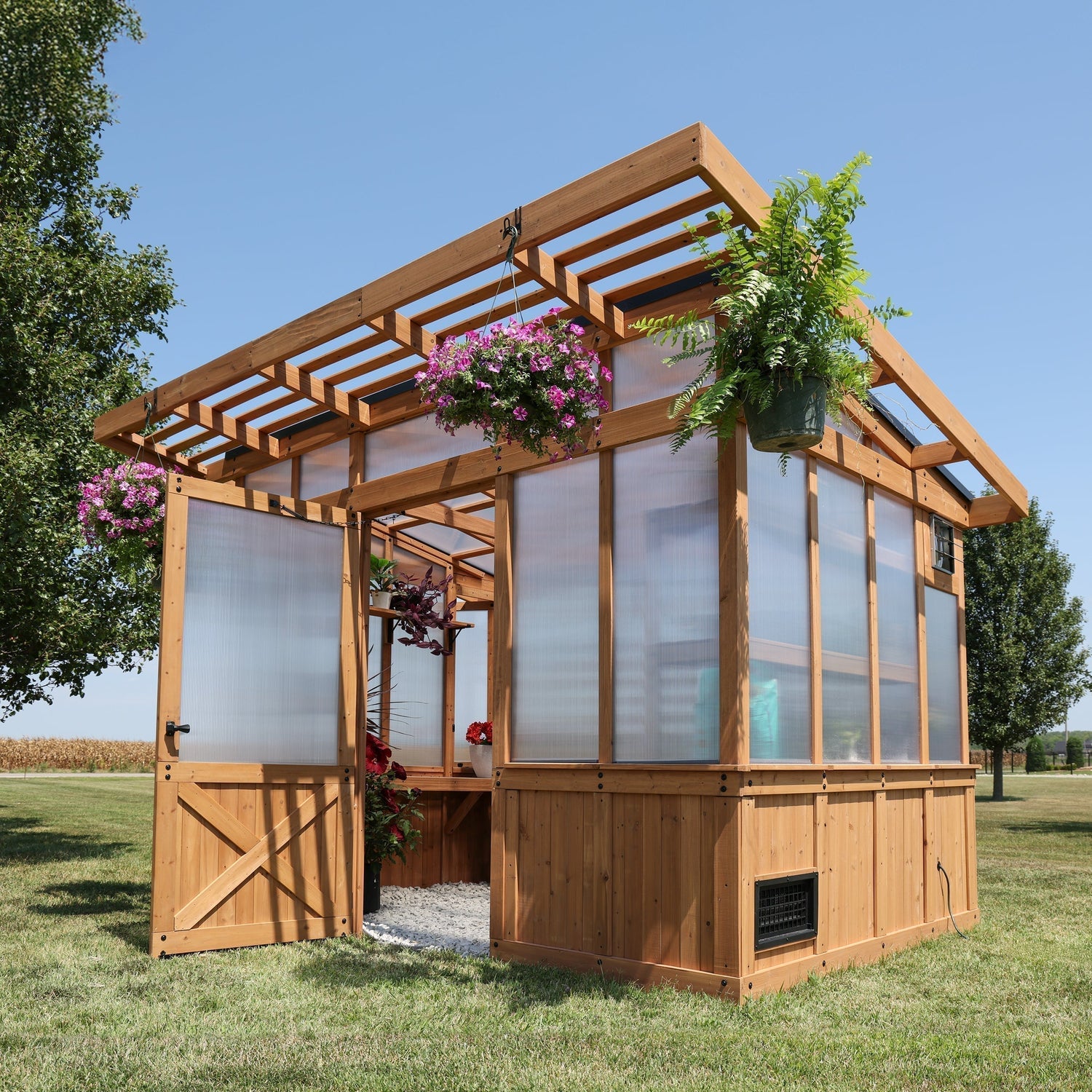
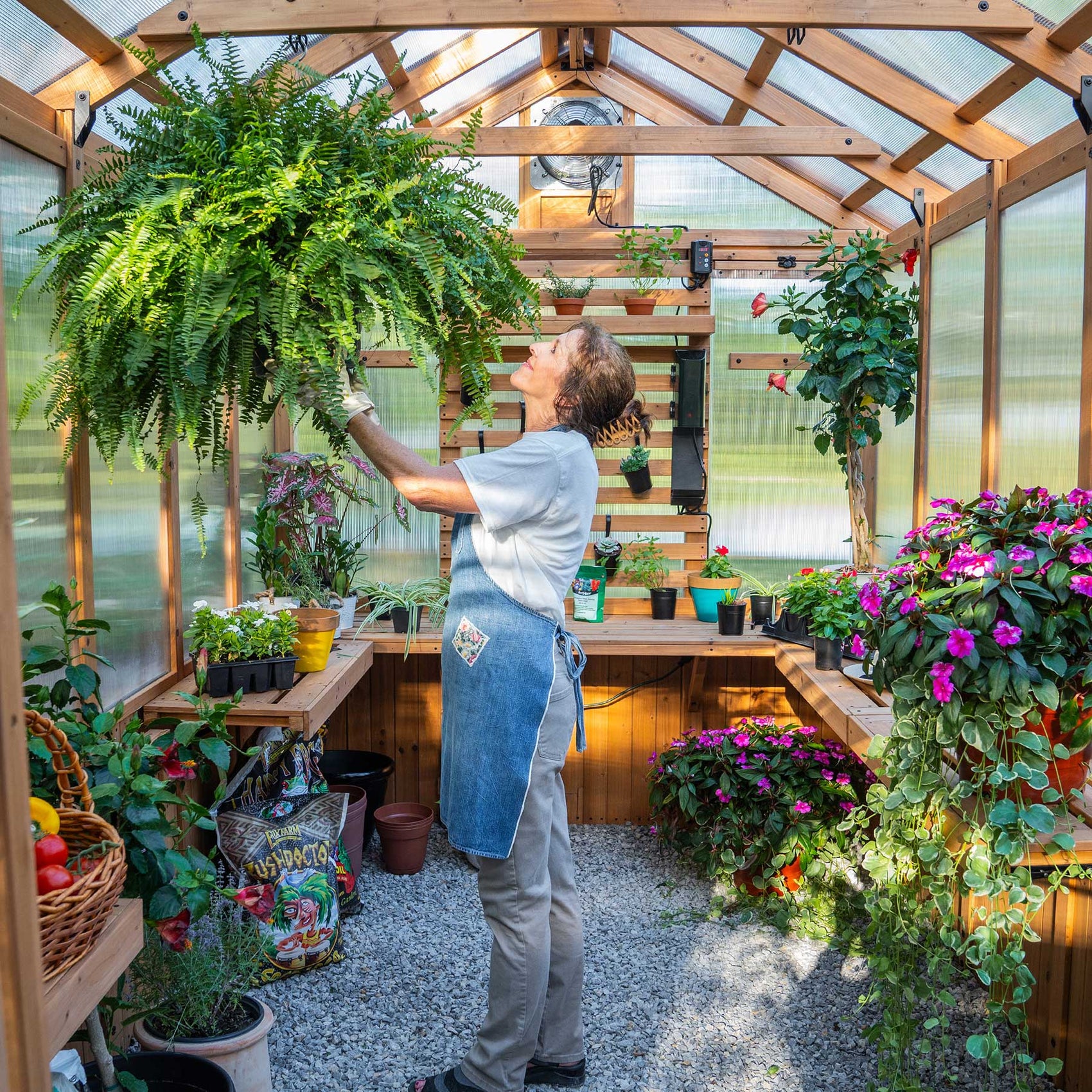
All of Backyard Discovery's greenhouses come standard with a thermostat-activated exhaust fan as a complete package, designed to mount on the upper wall and positioned to pull hot air out through the top while the intake shutter on the opposite side draws cooler replacement air in at a lower level. The fan plugs into the thermostat, you set your target temperature, and the system runs automatically. This positioning follows the same high-exhaust, low-intake airflow pattern covered in the vent sizing section above, and because it is included in every model, you do not need to budget separately for a fan or thermostat. The largest models, the Savannah and the Larkspur, include two.

Where to mount a greenhouse exhaust fan
If your greenhouse does not come with a fan pre-installed, mount it as high as possible on one end wall. Hot air rises and collects at the roofline, so placing the fan high captures the hottest air first. The intake opening, whether a vent, window, or shutter, should be on the opposite end of the greenhouse and as low as practical. This creates the longest possible airflow path through the structure, which means the incoming cool air passes over the maximum number of plants before it exits.
What a properly sized greenhouse exhaust fan looks like
A commonly cited guideline for summer ventilation is one complete air exchange per minute; a standard derived from commercial greenhouse research that translates well to hobby-scale structures. To find that number for any greenhouse, multiply the floor area by the average interior height. For a compact greenhouse with 54 square feet of floor space and an interior height of about 7 feet, that works out to roughly 378 cubic feet of interior volume and a target of 400 CFM. Larger greenhouses are typically taller, so both floor area and height increase together.
Quick-reference: fan sizing by greenhouse size
| Floor Area | Avg Height | Approx. Volume | Recommended Fan CFM |
|---|---|---|---|
| 54 sq ft | 7 ft | ~378 cu ft | ~400 CFM |
| 77 sq ft | 8 ft | ~616 cu ft | ~600 CFM |
| 84 sq ft | 8 ft | ~672 cu ft | ~700 CFM |
| 143 sq ft | 9 ft | ~1,287 cu ft | ~1,300 CFM |
| 161 sq ft | 9 ft | ~1,449 cu ft | ~1,450 CFM |
These volumes assume average interior heights of 7 to 9 feet, which is typical for most hobby greenhouses. If your greenhouse is taller or shorter, multiply your floor area by your actual average interior height to get your target CFM.
You do not need to chase the highest CFM number you can find. A fan rated for 400 to 500 CFM handles most compact greenhouses in the 50 to 60 square foot range. Mid-size greenhouses (75 to 85 square feet) need 600 to 700 CFM. For anything above 140 square feet, you will want 1,300 CFM or higher, or two smaller fans. Beyond about three air exchanges per minute, the cooling gains drop off sharply, so oversizing adds cost without meaningful benefit.
Greenhouse Circulation Fans: The Unsung Hero of Plant Health
Even with good ventilation moving air in and out of the greenhouse, you can still have dead air pockets inside the structure. These are zones, often in corners or behind dense plant groupings, where air sits still. Stagnant air creates localized heat buildup, elevated humidity right at the leaf surface, and ideal conditions for fungal diseases like powdery mildew, botrytis, and leaf mold.
A simple greenhouse circulation fan solves this. For compact greenhouses under 80 square feet, a small USB-powered clip fan mounted at plant height keeps air moving through the canopy. For larger greenhouses (80 square feet and up), look for a 6 to 8 inch oscillating fan rated at 100 CFM or higher, positioned to sweep across the full growing area. The goal is not to create wind but rather a gentle, continuous breeze that prevents moisture from sitting on leaf surfaces and distributes CO2 evenly to every plant.
Circulation fans also strengthen plant stems. Just as outdoor wind encourages thicker, sturdier growth, gentle indoor airflow prompts plants to invest in structural support. Seedlings grown with light air movement are noticeably stockier and more resilient when transplanted outdoors.
For pollination, circulation is especially important. Tomatoes, peppers, and other self-pollinating crops need physical agitation to release pollen. Outdoors, wind and bees handle this. Inside a greenhouse, a fan providing light airflow can improve fruit set significantly. If you notice your greenhouse tomatoes flowering but not setting fruit, insufficient air movement is the most likely cause.
If your greenhouse has a built-in electrical system like Backyard Discovery's PowerPort™ (three outlets and three USB ports), powering a circulation fan is as simple as plugging it in. No extension cords, no outdoor outlet needed, and the door stays sealed so your greenhouse holds its temperature.

How to Cool a Backyard Greenhouse: Seasonal Ventilation Strategies
Your backyard greenhouse's ventilation needs change with the seasons. What works in July will waste heat in January, and what conserves warmth in December will cook your plants in May.
Spring: managing the daily temperature swing
Spring is the trickiest season for greenhouse ventilation because the temperature swing between morning and afternoon can be enormous. It might be 35°F at dawn and 85°F inside the greenhouse by early afternoon. Your exhaust fan handles the afternoon spike, but you want to avoid venting so aggressively in the morning that you lose the warmth your seedlings need. If your fan is thermostat-controlled, it manages this transition automatically. If not, open windows by mid-morning and close them before the evening temperature drops. Your circulation fan should be running continuously through this period to keep air moving evenly across your seedlings.
Summer: maximum airflow
In the hottest months, everything opens. Windows, vents, exhaust fan, circulation fan. Your goal is to keep the interior temperature within 5 to 10 degrees of the outside temperature. If your exhaust fan is thermostat-controlled, it will be running for most of the day during peak summer. Let it. This is the season it was built for. Your circulation fan should run continuously to keep air moving through the canopy and help with pollination while your plants are in full production. If temperatures still climb above 90°F with everything running, shade cloth is the most effective next step, and the section below covers how to choose and install it.
Fall: the reverse transition
As nights get cooler, you want to start retaining heat again. Gradually reduce ventilation by closing windows earlier in the afternoon and keeping them closed on cooler mornings. The exhaust fan still handles any warm-day spikes, but you are no longer running it all day. Your circulation fan stays on. Even as you reduce ventilation, consistent air movement prevents the stagnant pockets where moisture and disease build up. If you planted cool-season crops for fall harvest (lettuce, spinach, kale), they actually prefer temperatures between 45 and 65°F, so you have more tolerance for cooler conditions than you did with summer crops.
Winter: minimum ventilation, maximum caution
This is where people make the biggest mistake. They seal the greenhouse completely to trap heat and end up creating a humid, stagnant environment where fungal disease thrives. Even in the coldest months, you need some air exchange.
The purpose of winter ventilation is humidity control, not cooling. When your greenhouse is sealed and the sun warms it during the day, moisture evaporates from soil and transpires from leaves. With nowhere to go, it condenses on every cold surface: the glazing, the frame, even the plants themselves. A sealed greenhouse also traps the air your plants are breathing. Plants can deplete CO2 to levels that slow or stop photosynthesis within a few hours, and regular air exchange is the only way to replenish it from outside air. University extension research, including guidance from UF IFAS, consistently identifies 80 percent relative humidity as the threshold where fungal disease risk rises sharply, with rapid development above 90 percent.
The solution is to crack a window for an hour or two on sunny winter days or let the exhaust fan run briefly during the warmest part of the afternoon. You lose a little heat in exchange for removing a lot of moisture, and that trade-off is almost always worthwhile. Keep your circulation fan running at low speed through winter as well. Air movement matters most when the greenhouse is closed up, because stagnant air lets moisture settle on leaf surfaces overnight, which is how fungal disease takes hold.
Greenhouse Shade Cloth: Cooling, Light Management, and Selection
Greenhouse shade cloth is the most cost-effective way to reduce interior temperatures during summer. A 30 to 50 percent shade cloth blocks that percentage of incoming solar radiation and can drop interior temperatures by 7 to 15°F depending on shade percentage and climate conditions. It works alongside your ventilation system rather than replacing it.
For selection, match the shade percentage to your climate and crops. A 30 percent shade cloth provides mild light reduction and is a good fit for temperate climates (Zones 5 to 7) where you want to take the edge off summer peaks without significantly reducing growing light. A 40 to 50 percent shade cloth is better suited for hot climates (Zones 8 to 10) or for growing shade-tolerant crops like lettuce and herbs during the hottest months.
Mount shade cloth on the south-facing wall or roof for maximum effect. Exterior mounting is more effective than interior for heat reduction, because it intercepts solar radiation before it enters the greenhouse rather than absorbing and re-radiating heat inside. South-facing coverage provides the best return per dollar of material.
Evaporative Cooling: When Ventilation and Shade Cloth Are Not Enough
For greenhouse owners in hot, dry climates (Zones 8 to 10) who still struggle with temperatures after maximizing ventilation and shade cloth, evaporative cooling systems (sometimes called swamp coolers or pad-and-fan systems) are the next step. These systems pump water over cooling pads while a fan draws air through them, dropping temperatures dramatically.
Evaporative cooling works best when outdoor relative humidity is consistently below 50%. If your summer afternoons regularly exceed 60% outdoor humidity, which is common in the Southeast, Gulf Coast, and many coastal areas, evaporative cooling will add moisture without meaningful cooling benefit. Pumping more moisture into an already humid greenhouse can push interior humidity above 90 percent, which is the threshold for rapid fungal disease development that the rest of this guide is designed to prevent.
How Ventilation Controls Greenhouse Humidity
Humidity inside a greenhouse is directly controlled by ventilation. There is no separate "humidity system" in most home greenhouses. If humidity is too high, you ventilate more. If humidity is too low (rare in a greenhouse, but possible in very dry climates), you ventilate less and add moisture through misting or open water trays.
Here is the framework to keep in mind, because the same numbers apply whether you are managing a spring afternoon or a sealed winter morning:
| Relative Humidity | What It Means and What to Do |
|---|---|
| Below 50% | Too dry. Increase misting or reduce ventilation. |
| 50–70% | Target range for most greenhouse crops. |
| 70–80% | Caution zone. Increase airflow and check watering habits. |
| 80–90% | Elevated risk. Fungal disease conditions are present. Increase ventilation immediately and check for condensation. |
| Above 90% | Dangerous. Rapid fungal development. Open everything. |
A simple hygrometer, often combined with a thermometer in a single device, gives you the data you need to manage this. Hang it at plant height, out of direct sunlight, and check it daily. If you see humidity consistently above 70 percent, increase airflow by opening vents or running the exhaust fan for longer periods. If you notice condensation forming on the inside of the glazing panels in the morning, that is a clear sign that nighttime humidity is too high, and you need more ventilation during the day to dry things out.

The Complete Greenhouse Ventilation System: A Simple Setup That Works
If you are evaluating greenhouse kits or building a ventilation system from scratch, here is the combination that covers roughly 90 percent of what a home greenhouse needs.
One thermostat-activated exhaust fan mounted high on one end wall. This is the workhorse. It handles summer cooling, shoulder-season temperature spikes, and humidity management. It turns on when things get too hot and turns off when they cool down, so you do not need to think about it.
One to two operable windows or vents on a different wall from the fan, preferably lower. These provide passive ventilation on mild days and serve as the intake path when the exhaust fan is running. The cross-flow pattern between low intake and high exhaust is the foundation of effective greenhouse ventilation.
One circulation fan inside the greenhouse at plant level. This keeps air moving through the canopy, prevents dead air pockets, reduces disease pressure, and aids pollination.
Three components. If your greenhouse kit includes all three or provides the electrical access to easily add the circulation fan, you have a ventilation system that will handle spring through fall without constant babysitting and winter with minimal adjustments.
Backyard Discovery's greenhouses include the first two components as standard equipment in every model: an exhaust fan with thermostat and easy-open windows with intake shutters positioned on the opposite wall to create the recommended cross-flow pattern. The PowerPort™ inside the greenhouse provides the outlet you need for a circulation fan or any other electrical accessory, with no extension cords and no compromise on the door seal. Browse the full Backyard Discovery greenhouse collections to find the right one for you.
For more on managing your greenhouse environment, see our beginner's guide for first-season setup.
Greenhouse Ventilation Guide: Frequently Asked Questions
Does a greenhouse need ventilation in winter?
Yes, but the goal changes. In winter you are ventilating to remove moisture, not to cool the space. Even 15 to 20 minutes of air exchange on a sunny afternoon can bring humidity down enough to prevent the condensation that leads to fungal problems. Watch your glazing panels in the morning. If you see water droplets forming on the inside of the panels, that is your signal that overnight humidity is too high and you need to vent more aggressively during the warmest part of the day, even if it costs you a few degrees of heat.
How do you cool a greenhouse in summer?
Work in order of priority. First, make sure your exhaust fan is running and every vent and window is open. Second, add a circulation fan at plant level if you do not have one. Third, if temperatures still climb above 90°F, install shade cloth on the south-facing wall or roof. A 30 to 50 percent shade cloth can drop interior temperatures by 7 to 15 degrees depending on conditions. Morning watering also helps because evaporation from damp soil pulls heat from the air, and the temporary humidity increase dissipates as ventilation moves air through the greenhouse during the day. Avoid evening watering, which raises humidity overnight when fungal pressure is highest. If you have done all of this and temperatures are still dangerous, check your vent area. Undersized openings are the most common bottleneck, and no amount of fan power fully compensates for them.
What size exhaust fan do I need for my greenhouse?
Fan power is measured in CFM (cubic feet per minute), which is the number you will see on the packaging. Multiply your greenhouse floor area by the average interior height to get your volume in cubic feet. That volume is your target CFM. A compact greenhouse around 54 square feet typically needs about 400 CFM. A mid-size greenhouse around 80 square feet needs 600 to 700 CFM. A large greenhouse over 140 square feet may need 1,300 CFM or more. The same fan handles all four seasons; you just run it more in summer and less in winter. Greenhouses above 140 square feet typically need two.
Do greenhouses need fans or just windows?
Windows alone handle ventilation on mild, breezy days, but they cannot keep up on still hot afternoons when a greenhouse can spike to dangerous temperatures in under two hours. Combining passive ventilation with at least one exhaust fan is the most reliable setup for temperature control. A circulation fan inside the greenhouse is a separate but equally important addition for preventing stagnant air, reducing disease, and helping with pollination.
How do you reduce humidity in a greenhouse?
Increase air exchange. Open vents and run the exhaust fan to replace humid interior air with drier outside air. If you are already ventilating and humidity stays high, look at your watering habits. Water in the morning so the soil surface dries during the day and avoid splashing water on leaves. A circulation fan helps by keeping air moving across leaf surfaces, so moisture does not sit long enough for fungal spores to germinate. The warning signs of a humidity problem are easy to spot once you know them: water droplets collecting at leaf tips, soft or translucent stems on seedlings, or a faint musty smell when you open the greenhouse in the morning. If you notice any of these, act before you see actual mold or mildew.
What temperature should a greenhouse be?
For most greenhouse crops, aim for 65 to 85°F during the day, with warm-season crops like tomatoes and peppers happiest in the 75 to 85°F range. At night, keep warm-season crops above 55°F, since growth stalls below that, while cool-season crops like lettuce, spinach, and kale prefer cooler conditions, around 45 to 65°F, and tolerate brief dips near freezing. A min/max thermometer is a simple way to monitor daily highs and lows so you can adjust ventilation and shading.

Leave a comment
This site is protected by hCaptcha and the hCaptcha Privacy Policy and Terms of Service apply.