


Updated July 2026
Shopping for a backyard greenhouse kit can feel like shopping for a car. There are dozens of brands, hundreds of models, and a dizzying range of prices from $200 pop-up greenhouses to $10,000+ premium kits. Some look nearly identical from the outside but differ significantly in materials, insulation, and what comes included. Others look wildly different but perform about the same.
The problem most buyers run into is not a lack of options. It is that they have no framework for evaluating those options. They compare prices without understanding what drives the differences, or they fixate on one spec like square footage while overlooking things that matter just as much, like how many walls your polycarbonate panels have, whether the ventilation runs on its own, or whether the manufacturer can actually show you structural test data.
This greenhouse buying guide gives you that framework. It walks through the decisions in order, from the broadest (your climate and growing goals) to the most specific (features and budget), so by the end you will know exactly what to look for and what to ignore, regardless of which brand you choose.
What Should I Look for When Buying a Greenhouse?
Focus on five factors in this order: size (buy larger than you think you need), glazing quality (4-wall polycarbonate at R~2.1 outperforms 6mm twin-wall at R~1.6 with roughly 30% better heat retention), frame material (cedar for natural insulation and a traditional look, galvanized steel and aluminum for zero maintenance), ventilation (an exhaust fan paired with windows), and published structural ratings with specific snow load and wind resistance numbers.
If the kit also includes built-in electrical access and hose hookups, that is a sign the manufacturer has thought through how people actually use a greenhouse, not just how it looks in a product photo.
Before You Shop: Five Questions That Shape Every Decision
What is your USDA hardiness zone?
Your zone determines what you can realistically grow and how hard your greenhouse needs to work to extend your season. A greenhouse for backyard use in Zone 8, where winters are mild and the growing season is long, has very different requirements from one in Zone 4, where the ground freezes solid for months. If you do not know your zone, check the USDA Plant Hardiness Zone Map.
Knowing your zone before you shop helps you focus on the right priorities. A Zone 9 gardener's biggest challenge is heat management, so ventilation and shade matter most. A Zone 4 gardener needs strong insulation, verified structural ratings, and a frame material that does not bleed heat overnight.
What do you want to grow, and when?
This question shapes everything from size to features. If your primary goal is starting seeds a few weeks early in spring and extending your tomato season into October, a smaller greenhouse kit with basic ventilation will serve you well. If you want to grow cold-hardy greens through winter, you need better insulation, specifically multi-wall polycarbonate that holds heat after sunset, and possibly supplemental heat. If you are envisioning year-round food production with herbs, vegetables, and overwintering citrus, you are looking at a larger structure with serious climate control, built-in electrical access for grow lights and heat mats, and enough staging shelves to run multiple growing zones at different heights.
Be honest with yourself about where you are starting. Most first-time greenhouse owners begin with spring seed starting and season extension, which is a wonderful and practical place to begin. Our greenhouse gardening for beginners guide covers first-season setup in detail.
How much outdoor space do you have?
Measure the area that gets at least 6 hours of direct sunlight and has access to water and power nearby. Leave enough room around the greenhouse for maintenance access and airflow. If that number is 60 square feet or less, you are looking at compact models. If you have 80–100 square feet to work with, mid-size greenhouses give you significantly more growing flexibility. Anything over 120 square feet opens up the full range of options, including the largest kits on the market.
As a good rule of thumb, orient your greenhouse with the ridge running east-west where possible so the south-facing roof maximizes winter sun exposure. This is particularly important in Zones 3–6, where low winter sun angles make orientation a meaningful factor in heat gain.
What is your realistic budget?
A good greenhouse is an investment that lasts 10–20 years, and the price differences between tiers usually reflect genuine differences in materials, features, and durability. As a general guide: under $500 you will find hoop houses and pop-up kits. In the $500–$1,500 range, expect entry-level polycarbonate greenhouse kits with basic ventilation. Between $1,500 and $3,000, you will find a wider selection of frame materials, panel options, and sizes to choose from. Above $3,000, expect the largest and most fully equipped kits on the market.
It's important to check what is actually included in the kit. Most brands still sell ventilation, electrical access, shelving, and other features as add-ons. What comes standard varies significantly by brand.
Check Local Building Codes
Before you order, check your local zoning and HOA regulations. Some communities regulate greenhouses by size, setback from property lines, or type (lean-to vs. freestanding). A quick call to your local building department can save you from an expensive surprise. Most freestanding hobby greenhouses under 120 square feet do not require a permit, but requirements vary by municipality and HOA.

What Size Home Greenhouse Do You Need?
The most common regret among greenhouse owners is buying too small. The second most common is not accounting for how much space shelving, walkways, and staging eat into the usable floor area. A 9x6 backyard greenhouse has roughly 54 square feet on paper, but once you account for shelves along two walls and a walkway down the center, your actual growing and working area is closer to 35–40 square feet of floor space. That is why it is worth paying attention to a number most buyers overlook: linear feet of shelving. A greenhouse with built-in staging shelves uses wall space vertically, adding significant growing capacity without requiring a larger footprint.
Here is a simple framework:
| Growing Goal | Recommended Size | Typical Fit |
|---|---|---|
| Casual herbs and a few seedlings | 40–60 sq ft | Compact models (9x6) |
| Serious vegetable gardening | 60–100 sq ft | Mid-size models (11x7, 12x7) |
| Year-round food production | 100–170 sq ft | Large models (13x11, 14x12, 14.5x12) |
If you are on the fence between two sizes and your space allows it, size up to the next model in the lineup. That extra growing capacity costs relatively little at the point of purchase but adds meaningful room you cannot retrofit later.
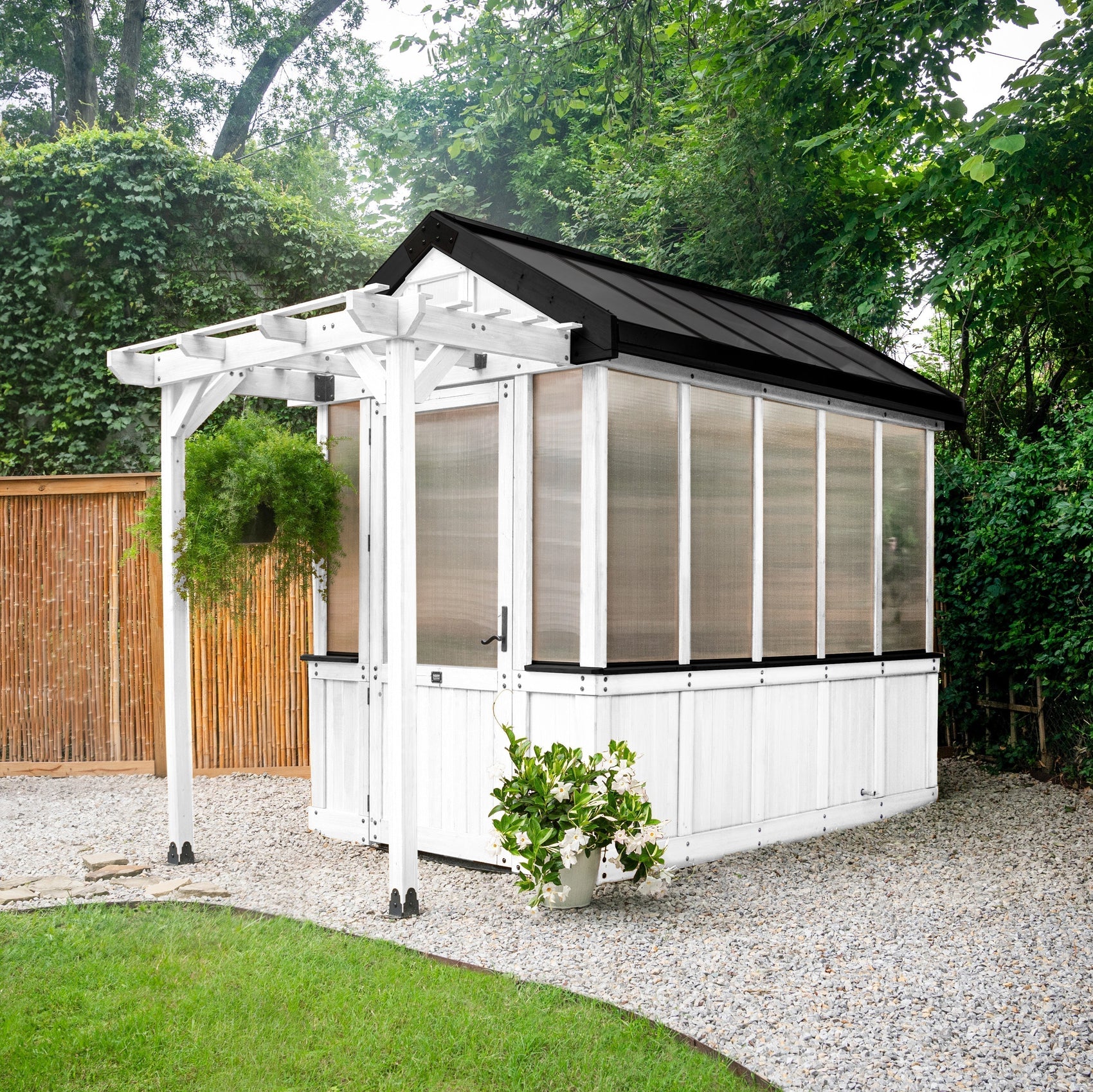
In the Backyard Discovery lineup, this range plays out clearly. The Willow (9x6) offers 54 square feet of interior space with 13 linear feet of staging shelves, enough for a dedicated herb garden and seed-starting station. The Poppy shares the same 9x6 footprint but packs 26 linear feet of shelving by using vertical space with a 4-tiered shelf rack, giving you roughly double the growing capacity of the Willow without a larger footprint. Step up to the Bellerose (11x7), and you get 83 square feet with 40 feet of staging shelves plus moveable hooks that let you hang plants. The Zalie (12x7) gives you 86 square feet with a modern contemporary design and foldable staging shelves that fold down to accommodate larger pots or trees on the floor below. For year-round production, the Bellerose XL (13x11) opens up 143 square feet with 48 linear feet of staging across upper and lower levels, four casement windows for serious cross-ventilation, and enough floor space to add raised planters in the center. The Savannah (14.5x12) offers 161 square feet with 55 linear feet of staging, the most shelving in the lineup, a built-in stainless-steel sink with hose hookup and exterior drain (all plumbing connections included), and four casement windows. At the Savannah's scale, it functions more like a working garden studio than a hobby greenhouse. The Larkspur (14x12) is the largest interior in the lineup at 163 square feet, with a galvanized steel and aluminum frame and 44 linear feet of staging rated to 500 pounds per shelf.
The floor area tells you how much room you have to move around; the shelving number tells you how much you can actually grow.
Greenhouse Roof Styles
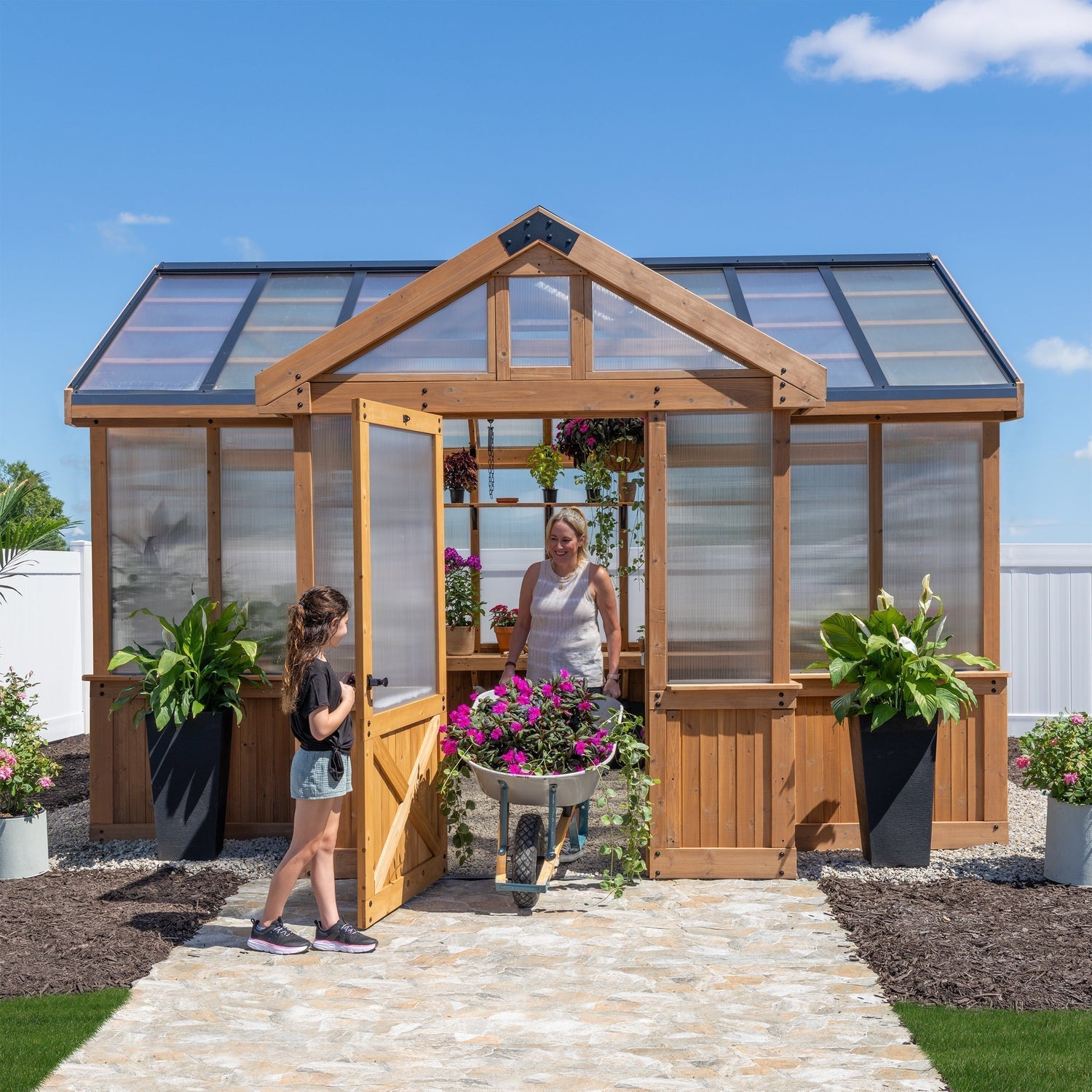
The two most common roof styles for backyard greenhouses are peaked and sloped. Peaked-roof (gable) designs offer the most interior headroom, shed snow evenly from both sides, and give you the most wall height for shelving. If you plan to overwinter tall plants or want maximum vertical growing space, a peaked roof gives you the most room to work with. In the Backyard Discovery lineup, the Bellerose, Bellerose XL, Savannah, and Larkspur all use peaked-roof designs.
Sloped-roof greenhouses use a single-pitch roofline for a clean, contemporary look. They tend to have a lower overall profile and a more modern aesthetic. The Willow, Poppy, and Zalie all use sloped-roof designs.
You will also see gothic-arch and hoop houses on the market, which are simpler to build and often less expensive, but their curved shape can struggle under heavy snow loads without reinforcement. Lean-to greenhouses attach to an existing wall and save space, but they limit light exposure to fewer sides and may require a permit since they are considered additions to your home.
Cedar vs. Aluminum vs. Steel: Choosing Your Greenhouse Frame Material
The frame is the skeleton of your greenhouse, and the material you choose affects insulation, maintenance, aesthetics, and how long the structure lasts.
Cedar
A cedar greenhouse is naturally resistant to rot and insects without chemical pressure treatment, which makes it an excellent choice for a structure that lives outdoors in a humid environment year-round. That chemical-free quality matters if you are growing food. In a greenhouse where warmth and humidity are constant, you do not want a pressure-treated frame off-gassing into an enclosed space.
Cedar also provides natural insulation, because wood conducts heat far more slowly than metal. A cedar frame loses less warmth overnight than an aluminum or steel one, which can contribute to lower heating costs in cold climates. That said, your glazing material has a larger impact on overall heat retention than your frame. For growers in Zones 3–6 who plan to heat through winter, cedar's insulating properties are a genuine advantage. In milder climates, frame material is less of a factor.
The trade-off is that cedar requires periodic maintenance. A coat of penetrating oil stain or sealant on the exterior every two to three years protects it from UV and moisture and keeps the wood looking its best. Without periodic staining or sealing, cedar will naturally turn gray over time, which is cosmetic rather than structural but worth knowing upfront. Some owners enjoy this as a seasonal ritual; others consider it a chore. When evaluating cedar specifically, look for FSC certification (which verifies the wood was sustainably sourced) and kiln-drying (which stabilizes the wood against warping and cracking once the greenhouse is up). Backyard Discovery's cedar is both, and arrives pre-stained for immediate weather resistance, though you will want to re-apply a sealant every two to three years to keep the wood performing and looking its best.
Aluminum
An aluminum greenhouse is corrosion-resistant and essentially maintenance-free. You will never need to stain it, seal it, or worry about rot. Aluminum is the most common frame material in the $500 to $1,500 price range, with thin cedar kits showing up in that tier as well over the past few years. If your budget is in that territory, you will find both materials available, though the cedar at this price point tends to be lighter-gauge and is not always FSC-certified or kiln-dried.
The trade-off is heat retention. Aluminum transfers heat faster than wood, which means it loses warmth from the greenhouse on cold nights and can create condensation points where the frame meets the glazing. Your glazing material has a larger impact on overall heat retention than your frame, but in cold climates the difference between frame materials can still contribute to higher heating costs over time.
Steel
Galvanized steel is the standard in commercial greenhouse operations for good reason: it handles extreme snow loads and sustained high winds better than most aluminum-framed greenhouses, with no corrosion risk and essentially zero maintenance. In large commercial structures where maximum rigidity and span length matter, steel is the default. Backyard Discovery's Larkspur brings that construction to residential scale with a galvanized steel and aluminum frame, oversized 4.7-inch corner posts, and wood-tone composite paneling that never needs painting, sealing, or staining.
For most backyard greenhouse owners, the choice comes down to priorities. Cedar offers natural insulation, rot resistance, and aesthetics that blend into a garden setting. A heavy-duty steel and aluminum frame offers maximum structural rigidity and zero seasonal maintenance. Both are strong choices at residential scale, and the right one depends on your climate, your aesthetic preferences, and how much upkeep you want to do.
Greenhouse Glazing: Why Panel Thickness and Wall Count Matter
We cover polycarbonate versus glass in full detail in our polycarbonate vs. glass greenhouse comparison guide, but here is what matters for buying purposes: polycarbonate is the better choice for most home greenhouses. It insulates well, diffuses light evenly (which actually reduces leaf burn compared to direct glass), resists impact, and costs less than glass. The key thing to understand when comparing greenhouse kits is that not all polycarbonate performs the same, and this is where many people end up with less insulation than they need without realizing it.

Twin-wall polycarbonate, meaning two layers separated by a single air channel, is what you will find in most kits under $1,500. It is adequate for mild climates and basic three-season use, but its insulation ceiling is limited. Commercial-grade 4-wall polycarbonate has four layers with three air chambers, achieving an R-value of ~2.1 compared to ~1.6 for the standard 6mm twin-wall. That roughly 30% improvement in heat retention means the greenhouse holds heat longer after sunset, which can extend your shoulder seasons and reduce heating costs if you add supplemental warmth. It is a higher-performance panel than the twin-wall polycarbonate found in most residential greenhouse kits, and it is the standard across every Backyard Discovery greenhouse. Not an upgrade or an add-on, but what comes standard.
When comparing kits, always check the panel thickness (measured in millimeters) and the number of internal walls. A greenhouse kit advertised simply as "polycarbonate" without specifying these details is almost certainly using the thinnest, cheapest option available.
Best Greenhouse Kit Features: What's Worth Paying For
Most greenhouse kits ship as an empty shell with everything else sold separately and left for you to figure out. Here are the features that make a real difference in how your greenhouse performs day to day.
Ventilation: non-negotiable
A greenhouse without adequate ventilation is a plant cooker. On a sunny 75°F day, an unventilated greenhouse can exceed 120°F inside within an hour. At minimum, you need one working window for passive airflow. Far better is a combination of windows and a thermostat-activated exhaust fan that kicks on automatically when the interior gets too hot, even if you are at work, running errands, or simply forgot to check. This pairing of passive and forced ventilation is what separates a greenhouse that works in the real world from one that only works on paper. Our greenhouse ventilation guide explains airflow design in detail.
Many greenhouse kits in the lower price tiers do not include an exhaust fan at all, which means you will need to source one separately, figure out the right CFM rating for your square footage — multiply your floor area by your interior height for a target of one air exchange per minute, which works out to roughly 400 CFM for a compact greenhouse and 1,300 or more for a large one — and install it yourself. Every greenhouse in the Backyard Discovery line ships with a thermostat-activated exhaust fan as standard equipment. The larger Savannah and Larkspur include two. When you are comparing kits, that inclusion alone saves you the cost and guesswork of retrofitting ventilation later.
Keep in mind that ventilation is not air conditioning. It manages heat buildup effectively on most days, but a greenhouse is fundamentally designed to trap solar energy, and on the hottest days of summer, even the best ventilation system will not fully overcome that. Good ventilation keeps your greenhouse usable across the widest possible range of conditions; it does not defy physics.

Electrical access: more useful than most buyers expect
When you first picture your greenhouse, you might imagine a purely passive structure where the sun comes in and the plants grow. In reality, you will want to plug things in sooner than you think: a heat mat for seed starting, a small fan for circulation, a Wi-Fi thermometer for peace of mind, maybe grow lights during the shorter days of late winter. That's four devices, and most greenhouse kits give you zero outlets inside.
Running an extension cord through the door sounds like an easy workaround until you realize the door no longer seals properly, which defeats the purpose of a climate-controlled space. Look for kits with built-in electrical access. Backyard Discovery's patented PowerPort™ is integrated into every model: three standard electrical outlets and three USB ports, positioned inside the structure where you need them.
Hose hookups: a small feature that makes a big daily difference
You'll water your greenhouse plants every single day during the growing season, and sometimes twice on hot summer days. An interior and exterior hose hookup lets you connect your garden hose on the outside and water from the inside without dragging hoses through the door or carrying watering cans back and forth. This sounds minor until you have done it daily for three weeks and realize it is the difference between enjoying your greenhouse time and dreading the watering routine. Look for greenhouses with dedicated water connections already plumbed in, because retrofitting hose access into a finished structure is awkward at best. Every Backyard Discovery model includes both interior and exterior hose hookups as standard.

Staging shelves: look at linear feet, not shelf count
Shelves are growing space. The more linear feet of shelving your greenhouse includes, the more plants you can stage at different heights and light levels. This is where the difference between floor area and actual growing capacity becomes dramatic. A greenhouse with 54 square feet of floor and 26 linear feet of staging shelves gives you far more growing capacity than a greenhouse with the same footprint but a single 6-foot shelf along one wall.
Moveable overhead plant hooks are worth looking for as well, since they let you hang trailing plants, drying herbs, or grow lights without losing shelf space. Across the Backyard Discovery line, staging shelves range from 13 linear feet in the compact Willow to 55 linear feet across upper and lower levels in the Savannah. The Poppy, Bellerose, and Zalie models fall in between, with built-in shelves and up to eight moveable plant hooks depending on the model.
Features you can skip for now
Automatic misting systems, shade cloth, supplemental grow lights, and drip irrigation are all valuable additions, but they are also easy to add later, especially if your greenhouse has a built-in power hub to run them from. Do not let the absence of these features in a kit dissuade you if the fundamentals (glazing, frame, ventilation, electrical, hose hookup) are strong. You can always upgrade your irrigation or lighting in year two. Replacing your glazing or frame material after the fact is a much bigger project, so getting those right from the start matters most.
Greenhouse Snow Load and Wind Resistance: The Section Most Guides Skip
This is arguably the most important section for anyone who lives in a climate with heavy snow or high winds, and it is the one most buying guides leave out entirely.
Snow load tells you how much weight your greenhouse roof can handle before it fails. Packed snow weighs roughly 12–18 pounds per cubic foot, and wet, heavy snow can exceed 20 pounds per cubic foot. A moderate snowfall of six to eight inches typically puts 7–12 pounds per square foot on your roof, and wet, heavy accumulation can push well past 15 pounds per square foot. If your greenhouse is rated for only 15 pounds per square foot, one good storm could compromise the structure. Look for ratings well above that threshold if you live anywhere that gets meaningful snowfall.
Wind resistance is measured in miles per hour. A greenhouse rated for 100 mph winds is well above what most locations will ever experience, but severe thunderstorms can produce gusts in the 60–80 mph range, and a greenhouse that folds in a storm is not just a financial loss but a safety hazard.
Here is the part most buyers miss: many greenhouse manufacturers do not publish independently tested structural data. They might describe their product as "durable" or "built to last," but if you ask for the actual load-tested numbers, they cannot provide them. When you are comparing kits, ask two specific questions: What is the tested roof load capacity in pounds per square foot? and What is the tested wind resistance in mph? If the answer is vague or unavailable, that tells you something.
Backyard Discovery publishes Pro-Tect™ ratings for every greenhouse model, verified through structural testing. Every model in the lineup meets or exceeds 50 pounds per square foot of roof load capacity, and all are rated for 100 mph winds. The total load rating varies by model because larger roofs carry more total weight at the same per-square-foot standard: the compact Poppy 9x6 is rated at 2,600 pounds total, while the full-size Savannah carries 9,950 pounds and the Larkspur 10,600. Having those specific numbers published makes comparison shopping significantly easier, because you are evaluating data rather than adjectives. See the full collection comparison table for ratings by model.
Greenhouse Cost: What You Get at Each Budget Tier
Price ranges in the greenhouse kit market correspond to genuine differences in what you receive. Here is a realistic breakdown of what each tier typically includes.
| Budget Tier | What You Typically Get | Typical Lifespan |
|---|---|---|
| Under $500 | Pop-up kits, hoop houses, PE cover over steel frame. No ventilation, no insulation, no electrical. No staging shelves. Seasonal use only. | 1–3 years |
| $500–$1,500 | Entry polycarbonate kits. Lightweight aluminum or thin cedar frame, twin-wall panels, basic vents. Fans, shelving, and electrical usually sold separately. | 3–8 years |
| $1,500–$3,000 | Mid-range kits. Cedar or heavy aluminum frames, better polycarbonate (twin-wall or 4-wall), more features included, published structural testing. Backyard Discovery's Willow, Poppy 9x6, and Bellerose 9x6 start here. | 10–20 years |
| $3,000–$6,000+ | Premium kits. Cedar or galvanized steel and aluminum frames, 10mm 4-wall polycarbonate, all features standard (ventilation, electrical, hose hookups, shelving), published structural testing, 5-year warranty. Backyard Discovery's Poppy 11x7, Bellerose 11x7, Zalie, Bellerose XL, Savannah, and Larkspur are here. | 15–25+ years |
Polycarbonate panels on any greenhouse may need replacement after 10–20 years depending on UV exposure and climate. Lifespan figures above refer to the frame and overall structure.
Keep in mind that lifespan depends not just on materials but on structural integrity: a thin aluminum frame held together with light-duty fasteners will not survive a storm the way solid cedar or heavy-gauge galvanized steel will, even if the raw material could technically last decades.
Also factor in your foundation. Depending on whether you go with compacted gravel, a timber frame, concrete pavers, or a poured slab, foundation costs can range from $100 to $3,000+ depending on type and size. Our greenhouse foundation guide walks through each option.
One pattern worth noting: some greenhouse kits advertise a low base price but sell essential accessories separately. Staging shelves alone run $150–$450 aftermarket, operable windows $150–$400, and an exhaust fan with thermostat $80–$200. Add plumbing, electrical, intake vents, and plant hooks, and the real cost of a 'budget' kit lands anywhere from roughly $600 to more than $1,300 above the sticker price. When comparing kits across brands, calculate the total cost of a greenhouse that is ready to use on day one, not just the base kit price.
What's Included in Every Backyard Discovery Greenhouse
We build our greenhouses as complete growing systems, not bare shells you need to accessorize. From the ventilation to the power hub to the hose hookups, everything you need to start growing is already in the kit. Here is what comes standard in every model and why each one matters:
Thermostat-Activated Exhaust Fan. The fan turns on automatically when the interior temperature rises past a set point, even when you are not there. This is the single most important feature for keeping plants alive on hot sunny days.
PowerPort™ Electrical System. Three standard outlets and three USB ports, built into the greenhouse interior. Run a heat mat, a circulation fan, a thermometer, and grow lights without ever running an extension cord through the door. This is our patented system, and you will not find it in other kits.
Interior and Exterior Hose Hookups. Connect your garden hose outside and water from inside. Daily watering is the single most time-consuming greenhouse task, and built-in plumbing makes it effortless instead of tedious.
Staging Shelves and Slat Wall. Every model includes a built-in slat wall and staging shelves, so your growing space is ready the day you finish assembly. Shelves turn wall space into growing space, letting you stage plants at different heights and light levels.
Commercial-Grade 4-Wall Polycarbonate Panels. Not twin-wall, not triple-wall. Every Backyard Discovery greenhouse uses commercial-grade, 10mm 4-wall polycarbonate that retains roughly 30% more heat than the twin-wall panels found in most kits (R~2.1 vs ~1.6).
Built to Last, in Cedar or Steel. Our cedar models use 100% FSC-certified, kiln-dried cedar, naturally resistant to rot and decay without chemical pressure treatment, with every piece pre-cut, pre-drilled, and pre-stained. The Larkspur uses galvanized steel and aluminum with wood-tone composite paneling, so it will not rust, warp, or corrode, and never needs painting, sealing, or staining.
BILT® App 3D Assembly Instructions. Interactive instructions on your phone let you rotate each step, zoom into joints, and see exactly where every fastener goes.
Pro-Tect™ Structural Testing. Every model has published, tested snow load and wind resistance ratings. No guesswork, no vague claims. Just specific numbers you can compare against any other kit on the market.
5-Year Comprehensive Warranty. Covers every component in the kit, and our support team is available seven days a week if you need help.
Free Driveway Delivery. Every order arrives on a box truck with a two-person crew, not a pallet dropped at the curb. Real-time tracking and a delivery photo on arrival.
For model-by-model differences in size, staging capacity, and structural ratings, see the full collection comparison below.

Compare Our Greenhouse Collections
Every Backyard Discovery greenhouse shares the same core: cedar construction, 4-wall polycarbonate, PowerPort™, exhaust fan, hose hookups, BILT® app instructions, and a 5-year warranty. Here is how the collections differ:
| Collection | Sizes | Interior | Shelving | Pro-Tect™ Load |
Ventilation | Standout Features |
|---|---|---|---|---|---|---|
| Larkspur | 14x12 | 163 sq ft | 44 ft (500 lb per shelf) | 10,600 lbs 100 mph |
4 windows, 2 fans | Steel and aluminum frame, magnetic window screens |
| Savannah | 14.5x12 | 161 sq ft | 55 ft (upper + lower) | 9,950 lbs 100 mph |
4 windows, 2 fans | Sink, chalet design, 8 plant hooks |
| Bellerose XL | 13x11 | 143 sq ft | 48 ft (upper + lower) | 9,200 lbs 100 mph |
4 windows, 1 fan | Pergola, 8 plant hooks |
| Bellerose | 11x7 | 83 sq ft | 40 ft (fixed + foldable) | 5,700 lbs 100 mph |
2 windows, 1 fan | Pergola, foldable shelves (11x7), 6 hooks |
| Bellerose | 9x6 | 54 sq ft | 19 ft (upper + lower) | 3,700 lbs 100 mph |
1 window, 1 fan | Pergola, 4 hooks |
| Poppy | 11x7 | 78 sq ft | 45 ft (incl. 4-tier rack) | 4,200 lbs 100 mph |
2 windows, 1 fan | Pergola overhangs, 4 hooks, 4-tier staging rack |
| Poppy | 9x6 | 50 sq ft | 26 ft (incl. 4-tier rack) | 2,600 lbs 100 mph |
1 window, 1 fan | Pergola overhangs, 4 hooks, 4-tier staging rack |
| Zalie | 12x7 | 86 sq ft | 23 ft (foldable + fixed) | 4,400 lbs 100 mph |
2 windows, 1 fan | Modern contemporary design |
| Willow | 9x6 | 54 sq ft | 13 ft (lower) | 2,800 lbs 100 mph |
1 window, 1 fan | Compact modern design, lowest entry price |
Select models are also available in a pre-stained white finish.
Explore the full lineup: Browse all Backyard Discovery greenhouses.
Greenhouse Kit vs. Building from Scratch
Building a greenhouse from scratch gives you total control over size, design, and materials. You can build exactly what you want, where you want it, to whatever specifications make sense. The trade-off is time, skill, and usually cost. A custom-built greenhouse can cost more than a comparable kit once you factor in materials, hardware, and labor, though the premium varies significantly by region and whether you hire a contractor or build yourself.
A well-designed greenhouse kit gets you a ready-to-assemble structure with pre-cut, pre-drilled components, engineered connections, and step-by-step instructions. The best kits can be assembled by two people in a weekend without specialized tools. But there is a meaningful difference between a true ready-to-assemble kit and a "kit" that is really just bundled raw materials with a paper diagram. When evaluating assembly, look for two things: are the pieces pre-cut and pre-drilled (not just pre-cut), and are the instructions interactive or at least visual (3D guidance you can rotate and zoom is now the gold standard).
Backyard Discovery's greenhouse kits arrive with every cedar component pre-cut, pre-drilled, and pre-stained, and include 3D interactive assembly instructions through the BILT® app on your phone. You can rotate each step, zoom into specific joints, and see exactly where each fastener goes. Every model also comes with a 5-year warranty covering all components and published structural testing data.
For most homeowners, a kit is the right choice. You get professional engineering without professional costs, and you can spend your weekends growing instead of building.
Your greenhouse will also need a level foundation. The most common options are compacted gravel (simplest and cheapest), a timber frame (simple with a more finished look), concrete pavers (more permanent), and a poured concrete slab (most durable but highest cost).
Best Backyard Greenhouse: Your Pre-Purchase Checklist
Before you commit, run through this list. If a greenhouse checks all of these boxes, you are making a solid investment regardless of brand.
Glazing: Is it 4-wall polycarbonate? How many walls? What thickness in millimeters? If glass, is it tempered and double-pane?
Frame: Cedar, aluminum, or steel? Does the material match your climate and maintenance preferences?
Ventilation: At least one operable window and one thermostat-activated exhaust fan? Both passive and forced ventilation working together?
Electrical: Are outlets and USB ports included inside the greenhouse, or will you need to add a separate power accessory?
Hose hookup: Interior and exterior connections already plumbed in for daily watering?
Shelving: How many linear feet of staging shelves? Are plant hooks included?
Structural testing: Does the manufacturer publish specific snow load (in pounds/sq ft) and wind resistance (in mph) ratings? Are they independently tested?
Warranty: How long, and what does it cover? Look for a warranty that covers all components, not just the frame or panels separately. Check whether you can talk to a real person when you need help and whether replacement parts ship quickly.
Assembly: Is it DIY-friendly with pre-cut, pre-drilled components? Are instructions visual or interactive?
Total cost: What does the greenhouse cost when you include everything you need to actually use it? Factor in the foundation, any add-on accessories, and first-year supplies.
Backyard Discovery's greenhouses check every item on this list. The thermostat-activated exhaust fan, PowerPort™ electrical system, staging shelves, slat wall, interior hose hookups, and 5-year warranty are all included in the kit, with free shipping and no add-on accessories to chase down. See individual product pages for model-specific configurations. If you are ready to compare models, explore the Willow for compact spaces, the Poppy or Bellerose for mid-size growing, the Zalie for a modern 12x7 footprint, the Savannah for the most staging capacity, or the Larkspur for a maintenance-free steel and aluminum frame.
Want to go deeper on specific topics? Our polycarbonate vs. glass comparison breaks down glazing choices, the beginner's guide covers first-season setup, and the ventilation guide explains airflow in detail.
Greenhouse Buying Guide: Frequently Asked Questions
How much does a greenhouse cost?
Home greenhouse kits range from under $500 for basic pop-up kits to $10,000+ for premium structures with commercial-grade 4-wall polycarbonate insulation, integrated ventilation, and all accessories included. The sweet spot for most serious home growers is $1,500–$3,000, where you get durable materials, proper ventilation, and a structure that will last 10–20 years. Keep in mind that the price on cheaper kits often does not include essential accessories like exhaust fans, shelving, and electrical outlets, which can add anywhere from roughly $600 to more than $1,300 to the real cost. When comparing, calculate the total cost of a ready-to-grow greenhouse, not just the base kit.
What size greenhouse do I need?
For casual herb gardening and seed starting, 40–60 square feet (a 9x6 model like the Willow or Poppy) is a solid starting point. For serious vegetable gardening, aim for 60–100 square feet (an 11x7 like the Bellerose or a 12x7 like the Zalie). For year-round food production, 100–170 square feet (the Bellerose XL at 13x11, the Larkspur at 14x12, or the Savannah at 14.5x12) gives you the space to run multiple growing zones with room to work. Whatever size you are considering, size up to the next model if your yard and budget allows it. The most common greenhouse regret is buying too small.
Is a greenhouse kit worth it compared to building from scratch?
For most homeowners, yes. A quality kit gives you pre-engineered components, tested structural ratings, a warranty, and visual assembly instructions without the time and complexity of a custom build. Custom-built greenhouses typically cost more once you factor in everything, though this varies by region. The main advantage of building from scratch is total control over dimensions and design, which matters if you have an unusual space or very specific requirements.
What should I look for in a greenhouse?
Five things in order of importance: glazing quality (10mm 4-wall polycarbonate retains roughly 30% more heat than 6mm twin-wall), frame material matched to your climate (cedar for natural rot resistance and insulation, aluminum or steel for low maintenance and durability), ventilation that includes both a thermostat-activated exhaust fan and windows, built-in electrical access so you are not running extension cords through the door, and published structural test data with specific load and wind numbers. Everything else is a nice-to-have that you can add later.
Do I need a permit for a greenhouse?
It depends on your local zoning and HOA regulations. Most freestanding hobby greenhouses under 120 square feet do not require a building permit, but requirements vary by municipality and HOA. Lean-to greenhouses attached to your home are more likely to need permits since they are considered additions to the structure. A quick call to your local building department before you order can save you from any surprises.

Leave a comment
This site is protected by hCaptcha and the hCaptcha Privacy Policy and Terms of Service apply.