


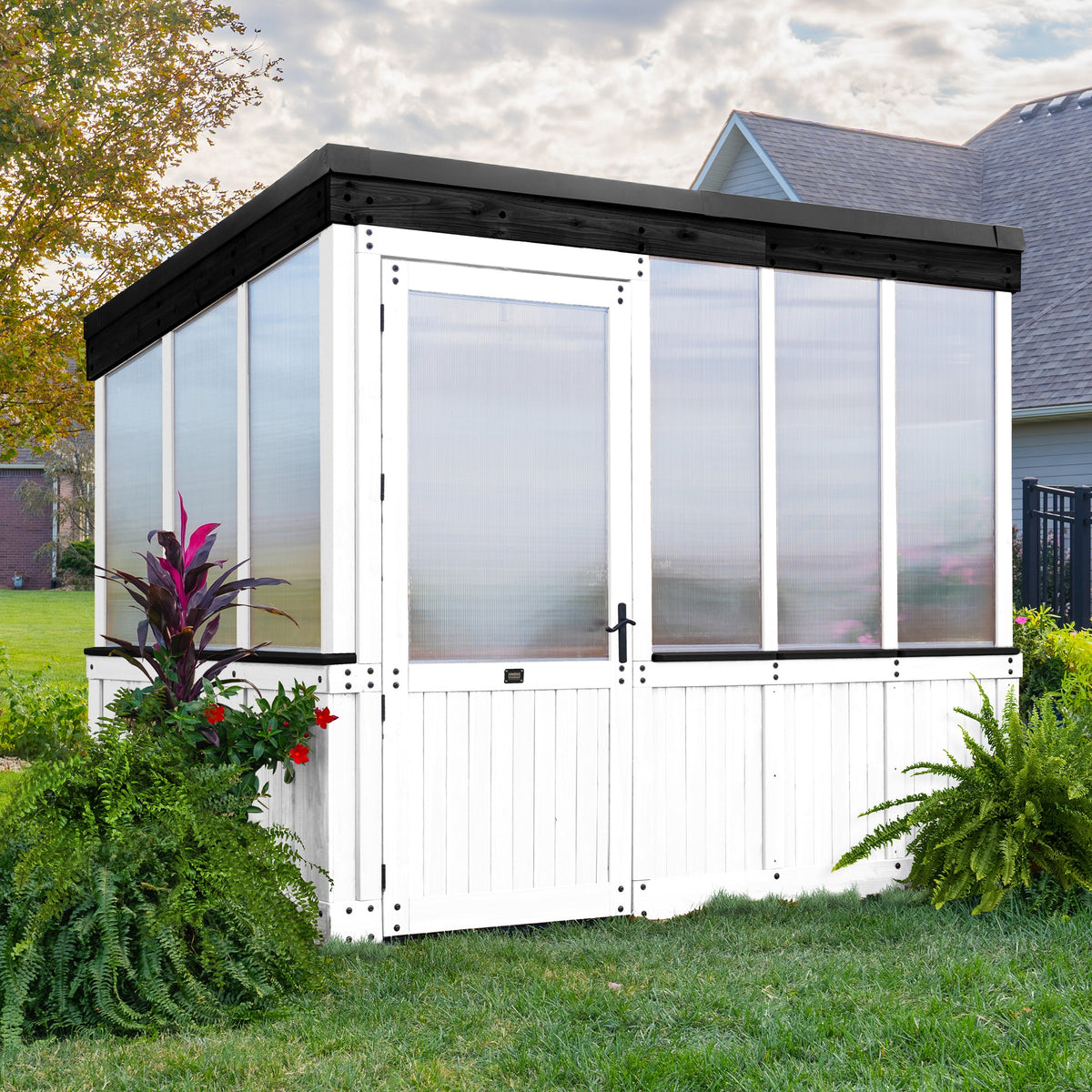
Updated August 2026
For a lot of gardeners, a home greenhouse is worth it, and the reason is time. It adds roughly six to eight weeks to each end of your season, which means seeds started in late winter while the ground is still frozen and tomatoes still ripening well past the first frost.
But it isn't a heated room, it doesn't run itself, and it won't fix a shady yard. Below we cover the benefits worth buying for, the drawbacks you might not know about, what a working greenhouse actually costs, and the cases where we'd tell you to wait.
Are Greenhouses Worth It?
A greenhouse is worth it if you want to start plants from seed, extend your growing season on both ends, grow food beyond what your outdoor beds allow, or overwinter tender plants that wouldn't survive outside.
It's less likely to be worth it if you want a warm tropical room through a northern winter without budgeting for heat, or if the only spot in your yard gets less than six hours of direct sun a day. Those are solvable problems, but they're problems to solve before you buy rather than after.
What Are the Benefits of a Greenhouse?
Six to eight weeks on each end of the season. This is the benefit that justifies the purchase for most people. You can start seeds in late winter while the ground outside is still frozen, and you can keep harvesting well after the first frost has ended your outdoor beds. In Zones 5 through 7 that six-to-eight-week gain is typical without any supplemental heat, with more in warmer zones and less in colder ones. Across a full year it adds up to roughly three additional months of growing, which changes what's realistic to attempt. Tomatoes that would never ripen in a short season have time to finish. Peppers and eggplant, which sulk in cool weather, get the warmth they need.
Control over the variables that ruin a season. Outdoors you're subject to whatever arrives. A hailstorm in June, a week of driving rain during flowering, an unseasonal frost in May that takes out everything you hardened off the weekend before. Inside a greenhouse those events happen to the roof instead of to your plants, and the glazing is what makes that true. 4-wall polycarbonate is rated at roughly 300 times the impact resistance of standard glass and is stronger than tempered safety glass, which is the difference between a hailstorm being a nuisance and a hailstorm being the end of your season. It's the panel we use across every model for exactly that reason. That protection is worth more in some climates than others, but everywhere it converts gardening from something you hope goes well into something you manage.
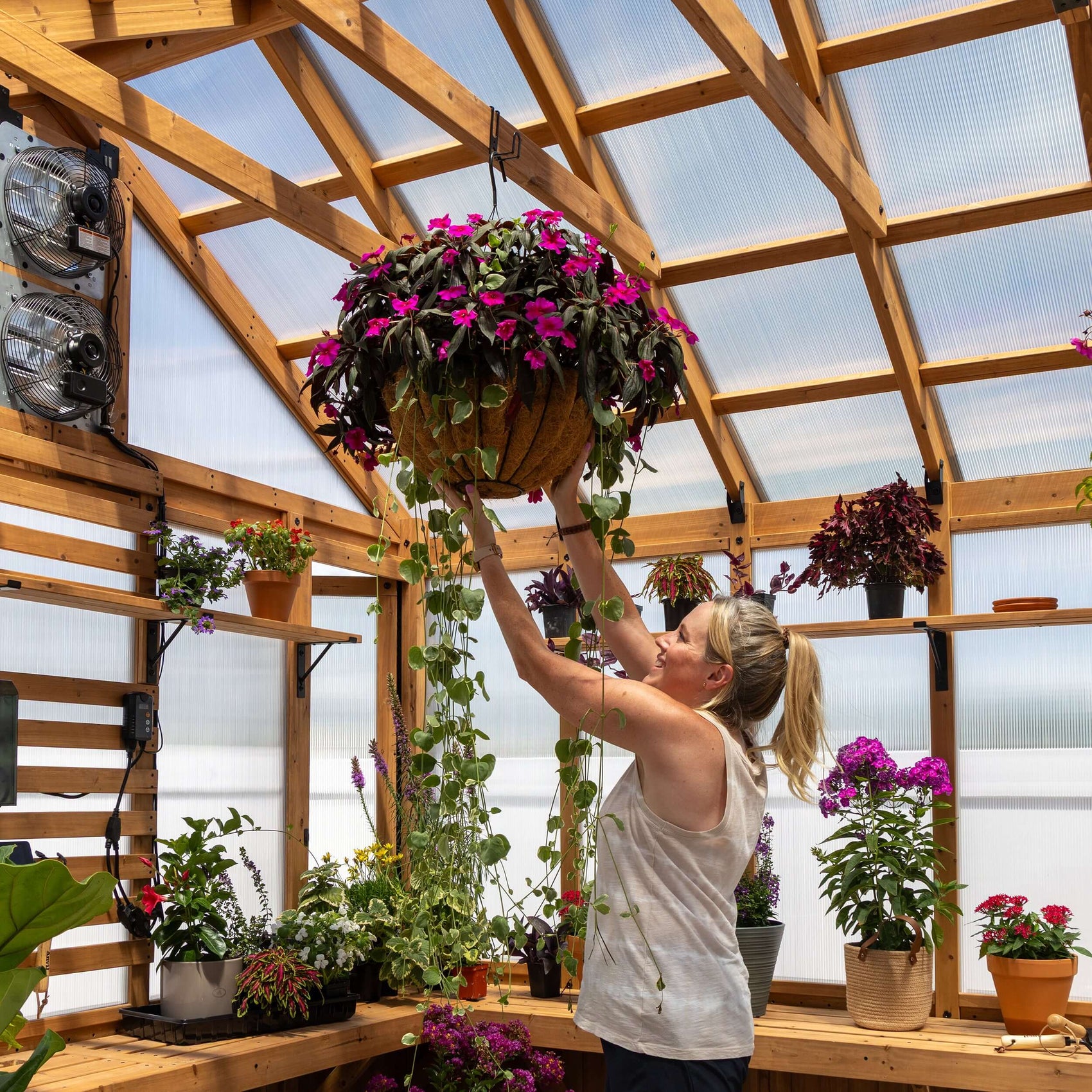
Seed starting on your own terms. A packet of seeds costs a fraction of what a flat of nursery starts costs, and it gives you access to varieties no garden center within an hour of you will carry. A greenhouse is where that becomes practical at any scale, because you get consistent warmth, real light, and somewhere to put the trays. That last part is worth checking before you buy: shelving is growing space, and it runs from 13 linear feet in a compact model up to 55 in the largest. Power matters too, since a heat mat in February is what gets warm-season seeds moving. Our PowerPort™ Electric Hub puts three outlets and three USB ports inside the structure, so a seedling heat mat or a grow light doesn't mean an extension cord run through a door that then won't seal.
Winter growing, depending where you live. In Zone 6 and warmer, cold-hardy greens like spinach and kale will produce through winter in an unheated greenhouse. In Zones 3 through 5, winter growing is possible but it requires well-insulated glazing and supplemental heat, which is a cost worth planning for rather than discovering in January. This is where the panel spec stops being a detail: single-pane glass sits at ~R-0.9, standard 6mm twin-wall polycarbonate at ~R-1.6, and the 10mm 4-wall polycarbonate we use across the lineup at ~R-2.1, which holds roughly 30 percent more heat than twin-wall. Our beginners guide has a planting calendar broken out by zone.

What Are the Disadvantages of a Greenhouse?
A greenhouse is not a heated room, and it doesn't defy physics. On a cold clear night, an unheated greenhouse will settle to within a few degrees of the outside temperature. Glazing slows that loss, and how much it slows depends on what you buy, but even the best panel isn't the same as keeping a space warm. Growing through a northern winter means supplemental heat regardless of what you own.
It also doesn't run itself, and the most common surprise for new owners is heat rather than cold. A closed greenhouse on a sunny 60°F spring day can reach 100°F by noon.
| Interior temperature | What happens |
|---|---|
| 85–90°F | Tomato and pepper growth slows |
| Above 95°F | Tomato pollen viability starts to decline |
| Above 100°F, sustained | Can kill young transplants within hours |
| Above 104°F, sustained | Can halt tomato fruit set almost entirely |
The answer is ventilation working two ways at once. Operable windows and a low intake vent for passive airflow, and a thermostat-activated exhaust fan that comes on at your set temperature whether or not anyone is home to flip a switch. Most kits sell one or both of those separately. Every Backyard Discovery greenhouse includes both as standard, with the fan mounted high on one wall and the intake positioned low on the opposite side to create the cross-flow the airflow depends on. Our ventilation guide covers fan sizing and humidity in detail.
And it doesn't eliminate pests. It changes which ones you have. Aphids, whiteflies, and thrips all thrive in the warm, still air of a greenhouse, and once established in an enclosed space with no natural predators, they multiply faster than they would outdoors. Airflow is your first line of defense, along with a weekly habit of actually looking at your plants, undersides of the leaves especially. The complication is that every opening that vents heat also lets insects in, and you want some of them — cucumbers and squash depend on insect pollination. Removable screens let you decide season by season rather than committing to one answer, which is how the Larkspur's magnetic window screens work: on during an aphid bloom, off while your cucurbits are flowering.
None of this is a reason not to buy one. It's a reason to know what you're taking on, and to check that the greenhouse you're looking at comes with the answers already in the box.
When to Wait
If your only viable spot gets less than six hours of direct sun. Light is the one input a greenhouse can't manufacture. Before anything else, watch the space across a full day and see what it actually receives, keeping in mind that a tree line which is bare in March won't be in July. If the spot falls short, it's worth looking at other parts of the yard before looking at greenhouses.
If you want tropical plants through a cold winter. This is entirely doable, and it means running heat, which means an electrical plan and a real line on your winter utility bill. Better-insulated glazing lowers that bill but doesn't remove it — a single-pane glass structure loses heat roughly 2.3 times faster than a 4-wall polycarbonate one. Worth pricing out before you buy rather than after.
If your site isn't level and you're not ready to fix it. A quarter inch of variance across the footprint is the working tolerance, and most yards are not that flat even when they look it. This isn't a reason to skip a greenhouse, it's a reason to budget a weekend and a few hundred dollars before the kit arrives rather than after. Our foundation guide covers the four options and what each costs.
If you're not sure you'll use it. There's a smaller way in. A cold frame box gives you a real season-extension experience for a fraction of the commitment, and if you find yourself out there every weekend in March, you'll have learned something useful about how much greenhouse you want.
How Much Does a Greenhouse Cost to Own?
Greenhouses run from roughly $200 for a pop-up to $10,000 and above for a premium kit.
The purchase price of a kit is frequently not the cost of a working greenhouse. Many kits arrive as a glazed shell, and the equipment that makes it functional is sold separately.
| Sold separately by many kits | Typical aftermarket cost |
|---|---|
| Staging shelves | $150 – $450 |
| Operable windows | $150 – $400 |
| Thermostat-controlled exhaust fan | $80 – $200 |
| Water line and electrical access | Varies by site |
| Added to the sticker price | $600 – $1,300 higher |
Not everything on that list is required on day one, but ventilation and somewhere to put plants are not optional.
This is worth checking carefully when you compare, because it's the difference between two prices that look similar and two purchases that are not. Every Backyard Discovery greenhouse includes a thermostat-activated exhaust fan, operable windows, 4-wall polycarbonate panels, staging shelves and a slat wall, PowerPort™ Electric Hub, and interior and exterior water hookups as standard equipment rather than upgrades. Our buying guide breaks down what each budget tier actually includes.
Then there's the foundation, which no kit price includes. A compacted gravel pad runs $100 to $400 in materials and serves most greenhouses under 120 square feet. A poured slab, which makes sense for the larger models, runs $500 to $3,000 or more.
The last cost is the one nobody quotes: what happens when something breaks in year four. A warranty that covers the frame but not the panels, or a brand with no parts pipeline, turns a cracked panel into a replaced greenhouse. Ours is a 5-year warranty covering every component in the kit, with replacement parts shipping from our U.S. warehouse within 48 hours and staying available for the life of the product, and a U.S.-based team of greenhouse specialists reachable seven days a week.
Against all of that, weigh what a greenhouse returns. Three additional months of growing every year, over a structure built to last a decade or more, is a long run of seasons you wouldn't otherwise have had.

Who Gets the Most Out of a Greenhouse
The seed starter. If you're already crowding a windowsill with trays every February, a greenhouse solves a problem you already have, and you don't need a large one to do it well. A compact model like the Willow at 54 square feet has room for staging and a work surface without taking over the yard. The Poppy shares that same 9x6 footprint but roughly doubles the growing capacity with 26 linear feet of shelving and a 4-tier rack.
The season extender. If your frustration is that the season is simply too short for what you want to grow, this is the benefit that will feel worth it the fastest. A mid-size model such as the Bellerose (11x7) at 83 square feet or the Zalie (12x7) at 86 gives you shelving for trays plus floor space for a few larger pots. Most models also include movable plant hooks, four to eight depending on size, which hang baskets and trailing crops without costing you a shelf.
The food grower. If you want meaningful vegetable production rather than a few plants, you want floor space for tall crops and shelving for everything else. That points toward the larger end of the lineup, like the Savannah or the Larkspur at 161 and 163 square feet, where 55 and 44 linear feet of staging mean the floor stays clear for the crops that need height. Both take a wheelbarrow through the door without unloading it first, and the Savannah adds a built-in stainless steel sink with the plumbing connected, so rinsing produce and washing tools happens where you're already standing. Our buying guide walks through how to think about it.
The collector. If you're hauling citrus, figs, or tender perennials into a garage every October and losing some of them anyway, a greenhouse is the answer to a problem you're already paying for in dead plants. Prioritize glazing that holds heat overnight over raw floor space, and check the door: every model of ours is wider than a standard greenhouse door and sized for a wheelbarrow, which is what a potted fig going in and out twice a year actually requires.
What Makes One Greenhouse Better Than Another
If the answer for you is yes, the next question is what actually separates one greenhouse from the next.
Glazing that holds heat overnight. Most consumer greenhouses use standard 6mm twin-wall polycarbonate, which comes in at ~R-1.6. Ours is 10mm 4-wall at ~R-2.1, with twice the walls and three times the insulating air chambers. That works out to roughly 30 percent more heat retained, which is the practical difference between carrying plants through a cold night and losing them.
Ventilation that doesn't need you. A thermostat-activated exhaust fan comes on at your set temperature and cycles off when the air cools. No switch, no propping the door, and no coming home in the evening to a greenhouse that spent the afternoon above 100°F. The Savannah and Larkspur include two.
Structural ratings that were tested and published. Every greenhouse we build carries a Pro-Tect™ rating for snow load and wind speed, verified through third-party structural testing. Every model meets or exceeds 50 pounds per square foot of roof load and is rated to 100 mph winds when properly anchored, and the anchoring hardware for both concrete and ground installation comes in the kit. If you live somewhere with real winters, that per-square-foot number is the one to ask any manufacturer for.
A build you can actually finish. A greenhouse only counts as worth it if it goes up. Every component arrives pre-cut, pre-drilled, and labeled, with no measuring or cutting left to you, and the free BILT® app walks the build in interactive 3D so you can rotate a step and zoom into a joint instead of squinting at a paper diagram.
A frame that suits how you want to maintain it. Our cedar models use FSC-certified, kiln-dried cedar, naturally rot and insect resistant, which asks for a coat of sealant every two to three years to hold its color. The Larkspur uses a galvanized steel and aluminum frame with wood-tone composite paneling that never needs sealing or staining. Both are covered by a 5-year warranty.
Browse all Backyard Discovery greenhouses
Are Greenhouses Worth It? Frequently Asked Questions
Are greenhouses worth the money?
For most gardeners, yes, provided you want what a greenhouse does. It adds roughly six to eight weeks to each end of your season, protects plants from hail, frost, and heavy rain, and makes seed starting practical at scale. The value depends on use. If you garden regularly and want a longer season or more control, it pays back quickly. If you garden occasionally, a cold frame or cold box may deliver enough of the benefit for far less.
What are the disadvantages of a freestanding greenhouse?
The main ones are heat management and attention. A freestanding greenhouse gains heat quickly and can reach 100°F on a sunny 60°F spring day, so it needs reliable ventilation rather than an open door. It's also exposed on all sides, which means it loses heat faster overnight than a lean-to sharing a house wall, and it requires a level, well-drained foundation. Our foundation guide covers the options. A thermostat-activated fan paired with low intake vents, and 4-wall polycarbonate rather than twin-wall, address most of the rest.
What is the purpose of a greenhouse?
A greenhouse creates a controlled growing environment by trapping solar heat and sheltering plants from wind, rain, hail, and frost. That lets you start seeds earlier, harvest later, protect tender plants through winter, and grow varieties your outdoor climate wouldn't otherwise support.
Can you use a greenhouse year-round?
In Zone 6 and warmer, an unheated greenhouse will produce cold-hardy greens through winter. In Zones 3 through 5, year-round growing needs well-insulated glazing and supplemental heat. Every greenhouse is usable year-round for overwintering dormant plants, which needs protection from freezing rather than active warmth.
Is a greenhouse worth it for a beginner?
Yes, and starting smaller is a reasonable choice. Most first-year owners use a greenhouse for spring seed starting and season extension, which a compact model handles well. Prioritize included ventilation and staging shelves over extra floor space, since those determine whether the greenhouse works from day one.

Leave a comment
This site is protected by hCaptcha and the hCaptcha Privacy Policy and Terms of Service apply.