


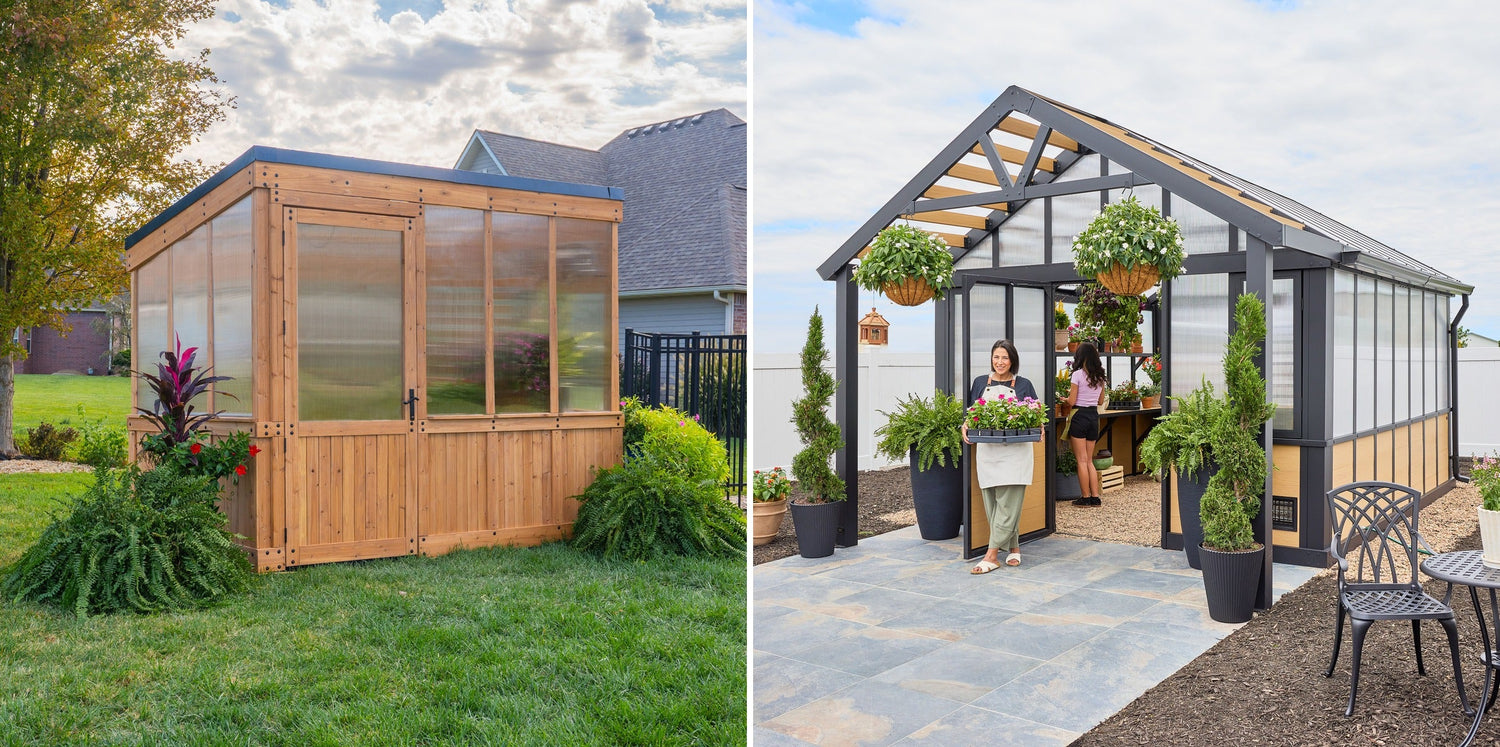
Updated July 2026
Most people size a greenhouse by floor area. That is the right place to start. It determines what fits in your yard, what you will pay, and it is the hardest thing to change once the structure is up.
It is just not the whole picture. A 9x6 greenhouse gives you 54 square feet on paper. Put shelves along two walls and leave a walkway down the center, and your usable floor is closer to 35 or 40. Two greenhouses can share the identical 9x6 footprint and one still offer twice the growing capacity of the other, depending on how much shelving is built in.
So, you are really working out two numbers: how much space your yard can hold, and how much growing surface that space gives you. Here is how to do both before you buy.
What Are the Common Greenhouse Sizes?
A small greenhouse of 40 to 60 square feet is enough for herbs, seed starting, and a few potted plants. A mid-size greenhouse of 60 to 100 square feet suits serious vegetable gardening. A large greenhouse of 100 to 170 square feet gives you room for year-round food production across multiple growing zones.
Then check the second number: linear feet of staging shelves. That figure tells you how much you can actually grow. Floor area only tells you how much room you have to walk around.
How Much Yard Space Does a Backyard Greenhouse Need?
Measure the area in your yard that gets at least six hours of direct sunlight and sits within reach of an outdoor spigot and is close enough to run power to. Leave room around the structure for maintenance access and airflow. Whatever that measurement is, it caps everything else.
- 60 square feet or less to work with: a small greenhouse on a 9x6 footprint
- 80 to 100 square feet: mid-size, 11x7 or 12x7
- 120 square feet or more: the full range, including the largest kits available
Two things people forget at this stage. First, a greenhouse with an attached pergola needs meaningfully more yard than its interior dimensions suggest, so measure for the whole structure, not the growing space. Second, orient the ridge east to west where you can, so the south-facing roof catches the most winter sun. That matters most in Zones 3 through 6, where low winter sun angles make a real difference in heat gain.

Greenhouse Shelving: The Number Behind Your Real Growing Space
Shelves are growing space. A greenhouse that turns wall space into staging holds far more than one with the same footprint and a bare wall.
Here is the catch: most greenhouse kits do not come with shelving at all. They ship as an empty shell. Staging is an accessory, sold separately, and it runs $150 to $450 aftermarket on top of a kit you have already paid for. The cost is only part of it. Retrofitting means either drilling into a frame that was not engineered to carry the load or setting freestanding racks on the floor space. When a kit ships without shelving, floor area is the only capacity number it has to offer.
Every Backyard Discovery greenhouse includes built-in staging shelves and a slat wall in the box at the base price, with movable plant hooks on most models. Across the lineup that runs from 13 linear feet in the compact Willow to 55 in the Savannah.
What that actually buys you shows up clearest inside our own lineup. The Willow and the Poppy share the same 9x6 footprint. The Willow includes 13 linear feet of lower staging. The Poppy includes 26, counting upper and lower levels and a freestanding 4-tier rack. That is the same corner of the yard doing about twice the work, and the only thing that changed is how the interior was designed.
So, when you compare kits, ask two questions: how many linear feet of staging are included, and is it in the base price. Square footage tells you how much room you have to move around. Shelving tells you how much you can actually grow.
Small, Mid-Size, or Large Greenhouse: Match Size to What You Grow
| Growing goal | Size to look for | Typical fit |
|---|---|---|
| Herbs, seed starting, a few pots | 40–60 sq ft | 9x6 models |
| Serious vegetable gardening | 60–100 sq ft | 11x7, 12x7 |
| Year-round food production | 100–170 sq ft | 13x11, 14x12, 14.5x12 |
Be honest about where you are starting. Most first-time owners begin with spring seed starting and season extension, which is a practical and rewarding place to begin. If that is you, a 9x6 with good vertical infrastructure will serve you well for years.
If you are planning to overwinter tender plants, run multiple growing zones at different heights, or bring a wheelbarrow inside, you are in mid-size territory or larger. Tall crops and raised planters in the center of the floor need walkway width and open floor space that compact footprints cannot give you.
Our greenhouse gardening for beginners guide walks through first-season planning in detail, including a planting calendar by zone.

How Much Does a Greenhouse Cost? Size vs. What's Included
Larger greenhouses cost more, but capacity is the hardest thing to change later. Shelving, irrigation, and lighting can all be added in year two. Footprint is the one that means starting over.
The bigger cost variable is not size at all. It is what comes in the box. Many kits advertise a low base price and sell the essentials separately: staging shelves run $150 to $450 aftermarket, operable windows $150 to $400, and an exhaust fan with thermostat $80 to $200. Add plumbing, electrical, and plant hooks and a "budget" kit can land well above its sticker price before it is usable.
Every Backyard Discovery greenhouse arrives ready to grow at its base price.
Thermostat-activated exhaust fan. Turns on by itself when the interior climbs past a set point, whether or not you are home. This matters more in a small greenhouse, not less — less air volume means it heats up faster on a sunny afternoon, not slower.
PowerPort™ electrical hub. Three outlets and three USB ports built into the interior, so a heat mat, a circulation fan, and grow lights all run without an extension cord snaking through the door. It is our patented system, and you will not find it in other kits.
Interior and exterior hose hookups. Connect your hose outside, water from inside. You will do this every day in season and twice on hot ones, which is why retrofitted hose access is a daily irritation rather than a one-time inconvenience.
Built-in staging shelves and a slat wall. Growing space ready the day you finish assembly, at every footprint.
Commercial-grade 10mm 4-wall polycarbonate. R-2.1 against the R-1.6 twin-wall most kits use, in the 9x6 exactly as in the 14.5x12. Our polycarbonate vs. glass comparison covers what that difference does across a season.
Built to last, in cedar or metal. Our cedar models use 100% FSC-certified, kiln-dried cedar, naturally resistant to rot and decay without chemical pressure treatment, with every piece pre-cut, pre-drilled, and pre-stained. The Larkspur uses a galvanized steel and aluminum frame that resists corrosion, paired with wood-tone composite paneling that needs no painting, sealing, or staining.
Pro-Tect™ tested ratings, BILT® app 3D assembly instructions, a wide entry door sized for a wheelbarrow, a 5-year comprehensive warranty, and free driveway delivery. Every size, no exceptions.
So when you compare sizes across brands, compare what each one costs ready to grow on day one. Our buying guide breaks down what each budget tier actually includes.
Is a Bigger Greenhouse Worth It? When to Size Up
Ask experienced greenhouse owners what they would do differently and most say the same thing: they wish they had gone bigger. It is rarely because they ran out of floor on day one. It is because the greenhouse turned out to be more useful than they expected. The seed-starting station meant to handle a few flats in March tends to still be full in July, and the overwintering shelf bought for three tender plants ends up holding nine.
The second thing that catches people out is how much room shelving and walkways actually take. That 9x6 gives you 54 square feet on paper, but with staging along two walls and a path down the middle, you are working with 35 to 40.
Sizing up is not free, though, and it is worth knowing the cost before you commit. A bigger structure carries more glazing, so it loses more heat overnight and takes more airflow to cool on a hot afternoon. The foundation scales with it too: a gravel pad for a 13x11 runs roughly $250 to $400 against $100 to $200 for a 9x6.
So the move is rarely to buy the largest greenhouse you can afford. It is to look hard at the next model up, particularly if the step is one footprint size and your yard can take it. One step costs relatively little at the point of purchase and adds capacity that is expensive to add later. Several steps buys you a heating bill and a foundation you did not plan for.

Backyard Discovery Greenhouse Kits Compared by Size
Every model shares the same core, whatever size you choose: 10mm 4-wall polycarbonate rated at R-2.1, which holds roughly 30% more heat than the 6mm twin-wall (R-1.6) found in most kits, thermostat-activated exhaust fan(s), operable windows, PowerPort™ Electric Hub, interior and exterior hose hookups, built-in staging shelves and slat wall, a wide entry door sized for a wheelbarrow, BILT® app 3D assembly instructions, published Pro-Tect™ structural ratings, and a comprehensive 5-year warranty.
| Model | Size | Interior | Staging shelves | Roof | Pro-Tect™ load | Standout |
|---|---|---|---|---|---|---|
| Larkspur | 14x12 | 163 sq ft | 44 ft (500 lb capacity per shelf) | Peak | 10,600 lbs / 100 mph | Steel and aluminum frame, composite paneling, 5-inch aluminum gutters, magnetic window screens |
| Savannah | 14.5x12 | 161 sq ft | 55 ft (upper + lower) | Peak | 9,950 lbs / 100 mph | Stainless steel sink, chalet design, 4 windows, 2 fans, 8 plant hooks |
| Bellerose XL | 13x11 | 143 sq ft | 48 ft (upper + lower) | Peak | 9,200 lbs / 100 mph | Pergola with trellis roof, 4 windows, 8 plant hooks |
| Zalie | 12x7 | 86 sq ft | 23 ft (fixed + foldable) | Slope | 4,400 lbs / 100 mph | Contemporary design, foldable shelves, drop-down windows |
| Bellerose | 11x7 | 83 sq ft | 40 ft (fixed + foldable) | Peak | 5,700 lbs / 100 mph | Pergola with trellis roof, 6 plant hooks |
| Poppy | 11x7 | 78 sq ft | 45 ft (incl. 4-tier rack) | Slope | 4,200 lbs / 100 mph | Three-sided trellis roof for growing outside |
| Bellerose | 9x6 | 54 sq ft | 19 ft (upper + lower) | Peak | 3,700 lbs / 100 mph | Pergola with trellis roof, 4 plant hooks |
| Willow | 9x6 | 54 sq ft | 13 ft (lower) | Slope | 2,800 lbs / 100 mph | Compact modern profile |
| Poppy | 9x6 | 50 sq ft | 26 ft (incl. 4-tier rack) | Slope | 2,600 lbs / 100 mph | Most staging of any 9x6 in the lineup |
Pro-Tect™ ratings are published as total roof load, so the number climbs with the size of the roof. Every model is engineered to the same standard of at least 50 pounds per square foot and rated to 100 mph winds. A smaller greenhouse showing a smaller number is not a weaker structure. It is a smaller roof held to the same threshold.
Select models are also available in a pre-stained and sealed white finish.
Browse all Backyard Discovery greenhouses.
Whichever size you land on, the structure underneath it has to be level before anything goes up. Our foundation guide covers gravel, timber, pavers, and concrete with real costs for each.
Greenhouse Sizing: Frequently Asked Questions
What is a good size for a beginner greenhouse?
A 9x6 footprint, roughly 50 to 54 square feet, suits most first-year growers — enough for seed starting, herbs, and a spring-to-fall vegetable rotation. If your yard allows more, take it. But if a compact footprint is what fits, look closely at what is built into it: two 9x6 greenhouses can differ by twice the growing capacity depending on their staging shelves and plant hooks.
Do greenhouses come with shelving?
Most do not. Staging shelves are typically sold separately and run $150 to $450 aftermarket, which is why two greenhouses with the same footprint can differ enormously in what you can actually grow. Every Backyard Discovery greenhouse includes built-in staging shelves and a slat wall in the base price, from 13 linear feet in the compact Willow up to 55 in the Savannah. When you compare kits, ask whether shelving is included or an add-on.
What is a good small greenhouse for a backyard?
For most backyards, a small greenhouse on a 9x6 footprint fits comfortably and handles seed starting, herbs, and a spring-to-fall vegetable rotation. Look for one that uses its vertical space rather than one with slightly more floor area. Among 9x6 models, the Poppy carries 26 linear feet of staging including a 4-tier rack, and the Willow carries 13, so the same footprint can hold very different amounts of growing.
How much space do I need around a greenhouse?
Plan for the full exterior footprint, not the interior dimensions. Models with an attached pergola extend past the growing space at the entrance. Beyond that, two things set your clearance. Check your local setback requirements for accessory structures and your HOA rules before you choose a spot, since these vary by location and are the binding constraint in most yards. Then leave enough room to walk the perimeter for panel cleaning, seasonal maintenance, and airflow around the structure. Your assembly instructions specify the working clearance needed during the build itself.
Is it better to get a bigger greenhouse?
If your yard and budget allow it, usually yes. Ask experienced owners what they would change and most say they wish they had gone bigger. Shelving, irrigation, and lighting can all be added in year two. Footprint is the one thing that means starting over, so it is worth looking hard at the next model up before you decide.
How many square feet do I need to grow vegetables year-round?
Plan on 100 to 170 square feet for year-round food production. That gives you room to run multiple growing zones at different heights, keep walkways clear for a wheelbarrow, and place raised planters on the floor while still using wall shelving. In Zones 6 and warmer, cold-hardy greens can produce through winter without supplemental heat. In Zones 3 through 5, year-round growing requires well-insulated glazing and added heat.

Leave a comment
This site is protected by hCaptcha and the hCaptcha Privacy Policy and Terms of Service apply.