


Updated August 2026
Start shopping for a greenhouse and material options add up fast. Cedar. Pressure-treated pine. Aluminum. Galvanized steel. Wood-tone composite. PVC. Polyethylene film. Polycarbonate. Any greenhouse you look at will list what it's made of. Almost none of them tell you what that means a year in, when there's a foot of wet snow on the roof or the finish has gone gray.
The list narrows fast once you decide what you're actually building. Polyethylene film and PVC are used for hoop houses, which are cost-effective, easy to work with, and built to be replaced every few years rather than to stay standing for a decade. Untreated softwood belongs in the same category, because pine and fir rot quickly in the warm, humid conditions a greenhouse creates. What's left is three frame materials you'll find on permanent backyard greenhouses: wood, aluminum, and galvanized steel, with steel and aluminum often used together.
Those three aren't three tiers of quality, and the material on its own won't tell you which greenhouse is still standing in ten years. Two aluminum frames can differ enormously in what they'll survive. So can two cedar ones. What the material does decide is how the greenhouse lives in your yard. Whether you seal it every few years or never need to stain it at all. Whether it silvers to gray or doesn't change at all. Those are real differences and they are worth choosing between.
This guide covers each frame material in depth, the paneling below the glazing line, and how to judge the engineering behind any of them.
What Is the Best Material for a Greenhouse?
There is no single best material. For a permanent backyard greenhouse, three frame materials all work. Rot-resistant wood like cedar insulates naturally but needs sealing every two to three years. Aluminum never rusts and needs no finish maintenance. Galvanized steel carries the most load. For glazing, multi-wall polycarbonate insulates better than single-pane glass and is the practical choice for most home growers.
The more useful question is not which material is best, but which structure is engineered best. Ask for published snow load and wind ratings before you compare material names.
Greenhouse Frame Materials Compared
| Cedar | Aluminum | Galvanized Steel | |
|---|---|---|---|
| Finish maintenance | Seal every 2–3 years to hold color | No sealing or staining | No sealing or staining |
| Weathering | Silvers to gray if unsealed | Holds its finish; bare aluminum dulls with time | Unchanged while zinc coating is intact |
| What drives rigidity | Member dimension and joinery | Gauge, section dimension, and joinery | Gauge and section dimension; stiffest material of the three |
| Thermal behavior | Insulates; conducts heat slowly | Conducts heat readily | Conducts heat readily |
| Frame profile | Wider members | Narrowest sightlines | Moderate |
| Weight during assembly | Moderate | Lightest | Heaviest |
| Rot / rust risk | Naturally resistant to rot and insects | None | None while coating is intact |
Every row in that table is a trade rather than a ranking. Wood insulates but asks for a finish. Aluminum needs no attention but conducts heat. Steel carries the most load and is the heaviest to handle during a build. None of them is the compromise choice.

Wood Greenhouse Frames
Cedar has framed outdoor structures for a long time, and the reason is chemical rather than aesthetic. The heartwood contains natural oils and compounds that resist decay and insects without any chemical treatment, which is why cedar fence posts and shingles outlast pine ones by years in identical weather. In a greenhouse specifically, that matters more than it does in a fence, because you're creating a warm, humid enclosure that accelerates rot in any wood not naturally equipped for it. It also matters if you're growing food, since a naturally rot-resistant frame doesn't need the chemical preservatives a pressure-treated one relies on.
Wood is also an insulator, so a cedar frame doesn't draw warmth out of the structure the way a metal one can. On a cold night, when you're trying to hold onto whatever heat the greenhouse gathered during the day, that's a small but genuine advantage. It isn't the largest factor in your heat retention. It's still real.
Not all cedar is the same, and this is where the spec sheet earns its keep. Two things are worth confirming before you buy. FSC certification verifies the wood was sustainably sourced from responsibly managed forests. Kiln-drying removes moisture from the lumber under controlled conditions, so it resists warping and cracking better than green wood does. That stability matters most after the greenhouse is standing and the panels are already fitted into the frame. A listing that says only "cedar" isn't telling you whether you're getting either one.
What cedar asks of you is finish maintenance. Left alone outdoors, it weathers to a silver-gray. That's cosmetic rather than structural, and plenty of gardeners prefer the weathered look, but if you want the wood to keep its warm color, plan on a coat of penetrating oil stain or sealant every two to three years. Cedar resists rot and decay. It doesn't protect itself from sun.
Pressure-treated pine belongs in this conversation briefly. It's inexpensive and structurally adequate. But it warps more than cedar does, and in a warm, humid enclosure you don't want a pressure-treated frame off-gassing into the space. Most people don't enjoy looking at it in a garden they spend time in either. If you're building your own frame on a budget, it's defensible. In a kit, cedar is the better wood.
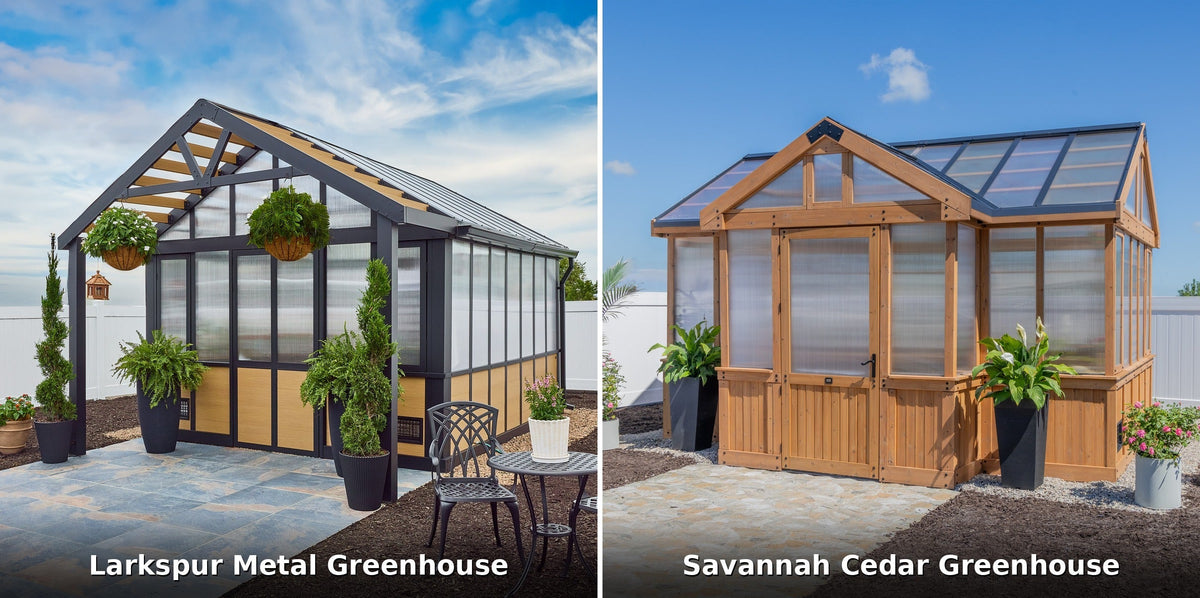
Our Willow, Poppy, Bellerose, Bellerose XL, Zalie, and Savannah greenhouses are built from FSC-certified, kiln-dried cedar, with peak, slope, and chalet-style rooflines. Every piece arrives pre-cut, pre-drilled, and pre-stained, so the wood is protected from day one and the finish decision is only about maintaining it, not applying it. Several models are also available in a pre-stained and sealed white finish.
Aluminum Greenhouse Frames
Aluminum is the most common frame material in kits in the $500 to $1,500 range, and the reasons are good ones. It doesn't rust, it never needs sealing or staining, and it's light enough that one person can move a wall section during assembly. It also extrudes into thin, strong profiles, which is an underrated advantage. Narrower frame members mean narrower sightlines, less structure standing between your plants and the sun, and more usable glazing area for the same footprint. In a small greenhouse, where every square inch of light matters, that's a meaningful difference.
Aluminum also anodizes and powder-coats well, which is why an aluminum-framed greenhouse holds its finish without staining or sealing.
The honest trade with aluminum is rigidity. Aluminum is roughly a third as stiff as steel by volume, so an aluminum frame's strength comes almost entirely from how much material is in each section and how the sections are joined. A lightweight big-box kit and a heavy-gauge aluminum structure from a serious manufacturer are both accurately described as aluminum greenhouses, and they won't behave remotely alike under a wet snow load.
Galvanized Steel Greenhouse Frames
Galvanized steel is the standard in commercial greenhouse operations, and the reason is load capacity. Steel is substantially stiffer than aluminum, which means a steel frame can span longer distances and carry heavier snow with less deflection. Galvanizing bonds a zinc coating to the steel that sacrifices itself to corrosion before the steel underneath does, so you get steel's strength without steel's usual weakness in a wet, humid environment.
In practice the two metals are usually combined rather than chosen between. Steel carries the structural load in posts and primary framing, while aluminum handles trim, glazing channels, and gutters, where corrosion resistance and light weight matter more than stiffness. That pairing isn't a compromise between the two. It's each metal doing the job it's actually best at.
The trade-offs are weight and thermal conductivity. A galvanized steel frame is heavier to handle during assembly than aluminum or cedar, which usually means a two-person build rather than a one-person one. And like all metal, steel conducts heat, which we take up below.
Our Larkspur is built on a galvanized steel and aluminum frame reinforced with oversized 4.7-inch corner posts, and it carries a Pro-Tect™ rating of 10,600 pounds of snow load and 100 mph winds, the highest structural rating in our current lineup. It's a peak-roof design at 163 square feet with 44 linear feet of staging shelves rated to 500 pounds each. The commercial-grade construction shows up in details you won't find on a hobby kit, including residential-grade 5-inch aluminum gutters with integrated downspouts and four operable windows with removable magnetic screens.

Greenhouse Wall Paneling: What Sits Below the Windows
A greenhouse isn't transparent all the way to the ground. On most walk-in models, polycarbonate covers the roof and the window line, and the wall below it is solid — cedar boards on a wood-framed greenhouse, composite panels on a metal one. That lower section does more work than it looks like it does. It absorbs splash back from rain, takes contact from tools, hoses, and wheelbarrow handles, and sits against the wet soil that ends up banked against any structure in a garden. It also sets the visual tone of the whole building, because it's the part at eye level as you walk up to it.
On our cedar models, those lower walls are the same FSC-certified cedar as the frame. They resist rot on their own terms and weather at the same rate as everything around them, which keeps the structure looking coherent as it ages. If you like that a wooden building changes over time, that's a feature rather than a cost.
Wood-tone composite panels are engineered to look like wood without behaving like it. Composite is a blend of wood fiber and plastic, and it doesn't rot, warp, absorb water, or need sealing or staining. Because the finish is manufactured rather than grown, it holds its color without any staining or sealing, and the flip side is that it will never develop the patina cedar does. Composite is a cladding material rather than a structural one, so you'll find it on panels and trim rather than in posts and beams. It solves the one problem metal framing can't solve on its own, which is that bare metal looks industrial. On the Larkspur, the wood-tone composite paneling is what lets a galvanized steel structure sit comfortably in a backyard.
Both are legitimate. One is a natural material you maintain and the other is an engineered material you don't.
PVC Greenhouse Frames and Polyethylene Film
PVC pipe and polyethylene film are the backbone of nearly every DIY hoop house on the internet, and they earn that position. They're cheap, light, easy to cut, and forgiving of imprecise measurement. For a seasonal tunnel you expect to re-cover every few years, they do exactly what they're supposed to do.
They are not permanent structures, and it's worth being clear about why. PVC becomes brittle under sustained UV exposure, losing impact strength over a handful of seasons, and it can't carry meaningful snow load in the first place. Greenhouse polyethylene film needs replacing every few seasons. If you're weighing a hoop house against a framed greenhouse, you aren't choosing between two versions of the same product. You're choosing between a season extender you rebuild periodically and a structure you put up once.
Do Metal Greenhouse Frames Lose Heat?
Metal conducts heat far more readily than wood, so every metal frame member creates a small path for warmth to escape the structure. That's real, it's measurable, and any comparison that leaves it out isn't being straight with you.
It's also a considerably smaller effect than most people expect. Glazing does roughly 85 to 90 percent of a greenhouse's insulating work. When you're comparing two greenhouses, the glazing spec will tell you more about heat retention than the frame material will.
Here's the comparison that actually moves the number. Most consumer greenhouse kits are glazed in standard 6mm twin-wall polycarbonate, which comes in at ~R-1.6. Every greenhouse we build, cedar or metal, is glazed in 10mm 4-wall polycarbonate rated at ~R-2.1, with twice the walls and three times the insulating air chambers. That works out to roughly 30 percent more heat retained.
So if heat retention is what you care about, ask about the glazing before you ask about the frame. Frame material matters. It matters less than the number of walls in the panel.

Greenhouse Glazing Materials: Glass and Polycarbonate
Glazing is the transparent or translucent surface that lets light in and holds heat. The two materials you'll typically encounter are glass and polycarbonate.
Glass transmits the most light, around 90 percent, and never yellows or degrades. It's also heavy, fragile, expensive to replace when it breaks, and insulates poorly in single pane at ~R-0.9. It suits display greenhouses and mild climates.
Polycarbonate is the practical choice for most home growers. It diffuses light rather than transmitting it directly, which reduces the hot spots and leaf scorch glass creates, and multi-wall constructions insulate far better than single-pane glass. Wall count is the spec that matters. 6mm twin-wall runs ~R-1.6, while 10mm 4-wall reaches ~R-2.1.
Our polycarbonate vs. glass comparison works through light transmission, insulation, durability, cost, safety, and climate fit in full detail.
How to Tell Whether a Greenhouse Frame Is Well Built
Two greenhouses made of the same material can be engineered to completely different standards. One holds a foot of wet snow and the other bends under it, and both listings say cedar. Or aluminum. Frame strength comes from wall thickness, gauge, member dimensions, and how the sections are joined, and none of those appear in a one-word material description. The material name isn't the variable. The engineering is.
Whatever the frame is made of, ask the manufacturer for the same two numbers: the tested snow load and wind rating. A published number gives you something you can hold against any other greenhouse on the market. "Heavy duty" and "built to last" give you nothing to compare. If the numbers aren't available, that absence is information too. A well-engineered aluminum greenhouse with published load ratings is a better structure than a poorly engineered cedar one, and that's true even though most of what we build is cedar.
This is why every Backyard Discovery greenhouse carries a Pro-Tect™ rating verified through structural testing rather than an estimate. Every model meets or exceeds 50 pounds per square foot of roof load and is rated to 100 mph winds. Total load varies with roof size, from 2,600 pounds on the compact Poppy 9x6 to 10,600 pounds on the Larkspur, but the per-square-foot standard is the same across the lineup. That's the number worth comparing brand to brand, since a bigger roof carries more total weight at any given standard. Our buying guide explains how to read those numbers against the snow and wind your own climate actually delivers.
How to Choose Between Wood and Metal
Once both structures are engineered to carry the load your climate delivers, the decision comes down to two questions that have nothing to do with strength.
How much finish maintenance do you want? Cedar asks for a coat of stain or sealant every two to three years if you want it to hold its color, and it'll silver to gray if you let it. Some gardeners enjoy that, the way people enjoy oiling a cutting board or waxing a jacket, and a freshly sealed cedar structure is a beautiful thing. Others would rather buy a greenhouse once and never open a can of stain. A metal frame with composite paneling doesn't need sealing or staining.
What do you want it to look like in your yard? Cedar reads traditional and warm and settles into an established garden the way a timber pergola does, changing color and character as it ages alongside everything planted around it. A metal frame with composite paneling reads cleaner and more architectural, holds its color, and looks much the same years later as it did in year one. Neither is more serious than the other.
We build in cedar, which is exactly why we can say plainly what wood does beautifully and what it asks in return. Cedar's warmth is inseparable from the fact that it's a living material that wants a little care. For a lot of gardeners, that trade is precisely right. The Larkspur exists for a different set of priorities, with the same engineering and the same standard features, in materials chosen to stay as they are year after year.
Whichever you choose, the greenhouse should arrive ready to grow in. Every Backyard Discovery model, cedar or metal, includes a thermostat-activated exhaust fan (two on the Savannah and Larkspur), at least one operable window, staging shelves and a slat wall, a patented PowerPort™ with three outlets and three USB ports, interior and exterior water hookups, 3D interactive assembly instructions through the BILT® app, a published Pro-Tect™ structural rating, and a 5-year warranty covering every component. Standard features, not upgrades.
Browse all Backyard Discovery greenhouses
Greenhouse Materials: Frequently Asked Questions
What materials is a greenhouse made of?
A greenhouse is made of three material groups. The frame carries the structural load and is typically rot-resistant wood, aluminum, or galvanized steel. The glazing is the transparent surface, usually polycarbonate or glass. The paneling fills the solid wall below the window line and is typically cedar on wood-framed greenhouses and wood-tone composite on metal ones. Hoop houses use PVC framing with polyethylene film instead.
What is the best material for a greenhouse frame?
There is no single best material. Rot-resistant wood such as cedar, aluminum, and galvanized steel are all legitimate choices for a permanent backyard greenhouse. Cedar resists rot and insects naturally and insulates well, but needs sealing every two to three years to hold its color. Aluminum never rusts and allows the narrowest frame profiles, but its rigidity depends on gauge and joinery. Galvanized steel carries the most load and is often paired with aluminum. Compare published snow load and wind ratings before you compare material names.
Do wooden greenhouses rot?
Cedar contains natural compounds that resist decay and insects, so it holds up outdoors without needing pressure-treatment. Untreated softwoods like standard pine will rot in ground contact and make a poor choice for a greenhouse frame. Any wood frame lasts longer on a foundation that drains well, which is why gravel pads and pavers are common under wood-framed structures. Our foundation guide covers each option.
Can you use pressure-treated wood for a greenhouse?
You can, and it's structurally adequate. But a greenhouse is a warm, humid enclosure, and you don't want a pressure-treated frame off-gassing into that space, which is worth considering if you're growing food. Pressure-treated pine also warps more than cedar does. For a kit greenhouse, naturally rot-resistant cedar is the better wood.
Is an aluminum greenhouse frame strong enough?
It depends on the frame, not on the metal. Aluminum is rust-proof and light but roughly a third as stiff as steel by volume, so strength comes from how much material is in each section and how the sections are joined. A heavy-gauge aluminum frame from a serious manufacturer and a lightweight big-box kit are both accurately called aluminum and won't perform alike. Many frames pair aluminum with galvanized steel, which carries the structural load. Rather than comparing metals, compare published snow load and wind ratings.
Do metal greenhouses get too hot or too cold?
Metal conducts heat more readily than wood, so a metal frame creates a small path for heat loss on cold nights. The effect is smaller than most people expect, because glazing does roughly 85 to 90 percent of a greenhouse's insulating work. Glazing specification matters far more. 10mm 4-wall polycarbonate at ~R-2.1 retains roughly 30 percent more heat than the standard 6mm twin-wall at ~R-1.6 used on most consumer greenhouses. Summer heat is a different question, and the frame plays almost no part in it. How hot a greenhouse gets on a sunny day is set by glazing and ventilation, which is why every model we build ships with a thermostat-activated exhaust fan and at least one operable window.
What is composite greenhouse paneling?
Composite paneling is an engineered blend of wood fiber and plastic designed to look like wood without absorbing water, rotting, or warping. It never needs sealing or staining and holds its color without them, which makes it a natural pairing with metal framing. It's a cladding material rather than a structural one, so you'll find it on panels and trim rather than in posts and beams. The trade-off is that it won't develop the patina real wood does.
Are PVC greenhouses any good?
For a temporary seasonal tunnel, PVC is inexpensive and easy to work with. It is not suitable for a permanent structure. PVC becomes brittle under sustained UV exposure and can't carry meaningful snow load, and the polyethylene film typically used with it needs to be replaced every few seasons. Treat it as a short-term or DIY solution rather than a long-term investment.
What is the best glazing material for a greenhouse?
For most home growers, multi-wall polycarbonate. It diffuses light to reduce hot spots and leaf scorch, resists impact far better than glass, and insulates significantly better than single-pane glass. Wall count is the spec that matters. 6mm twin-wall runs ~R-1.6 while 10mm 4-wall reaches ~R-2.1. Glass transmits more light and never degrades, but it's heavy, fragile, and insulates poorly in single pane.

Leave a comment
This site is protected by hCaptcha and the hCaptcha Privacy Policy and Terms of Service apply.