


You've decided you want a sauna. Now you're stuck on the question everyone lands on: infrared sauna or traditional sauna? They both make you sweat. They both have documented health benefits. But they heat your body differently, feel different to sit in, install differently, and cost different amounts to run.
If you're trying to decide between the two, the right choice depends less on which type is "better" and more on how you want your sauna sessions to feel, where you plan to put it, and what your goals are. This guide covers all of it without picking a side.
The quick answer
Choose a traditional sauna if you want intense heat, the steam ritual, and an outdoor experience you can share. Choose an infrared sauna if you want gentler warmth, longer sessions, and an easy indoor daily habit. Both deliver real, documented wellness benefits, and the guide below breaks down how they compare on feel, installation, cost, and research.
What Is the Difference Between Infrared and Traditional Saunas?
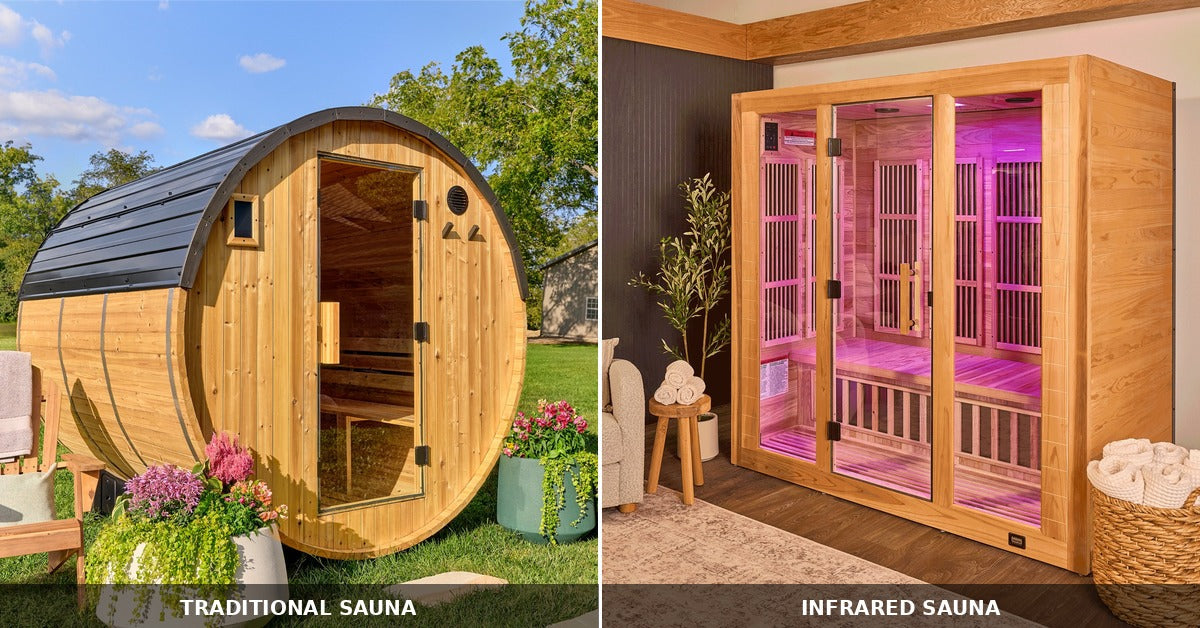
Traditional saunas heat the surrounding air to 150–194°F (65–90°C) using an electric heater with stones, with the option to create steam. Infrared saunas use infrared heating panels to warm your body directly at lower air temperatures (120–150°F / 49–65°C) without steam. Both raise your heart rate, improve circulation, and promote deep sweating, but the intensity and session experience are distinctly different.
How Infrared and Traditional Saunas Create Heat
The fundamental difference between these two sauna types comes down to one thing: what gets heated first.
Traditional Saunas: Heating the Air
A traditional sauna uses an electric heater (or, less commonly, a wood-burning stove) loaded with stones. The heater warms the stones, which radiate heat into the air. The sauna temperature climbs to 150–194°F (65–90°C), and your body heats up because the surrounding air is hot.
The optional steam is what makes traditional saunas distinct. When you pour water over the heated stones (a practice called löyly in Finnish) it creates a burst of humid heat that intensifies the sensation on your skin. This ritual is central to Finnish sauna culture and produces a feeling that infrared saunas can't replicate. Some sessions are entirely dry heat, which is why traditional saunas are sometimes called dry saunas, steam saunas, or wet/dry saunas. Others alternate between dry and steam. You control it.
Traditional saunas also create layered heat inside the room. Hot air rises, so the temperature near the ceiling can be 30–40°F (17–22°C) hotter than at floor level. This natural heat gradient means you can choose your intensity by sitting higher for more heat or lower for a milder experience. In multi-bench saunas, that's as simple as switching seats. In barrel saunas, where the bench is at a single level, the heat is more uniform, a design some actually prefer for its consistency.
Preheat time for traditional saunas depends on the heater. A 6kW model, the most common size in residential saunas, typically needs 40–60 minutes to reach full temperature. Higher-output heaters shorten that wait considerably. Backyard Discovery's traditional saunas use a proprietary 9kW PrairieFire™ heater that cuts preheat time roughly in half compared to standard 6kW models, depending on room size and ambient conditions. A Wi-Fi-enabled control panel lets you start preheating from your phone so the sauna is ready when you are.
Infrared Saunas: Heating the Body
An infrared sauna doesn't heat the air in the same way. Instead, heating panels made from materials like carbon or ceramic emit infrared heat — a form of radiant warmth similar to what you feel from sunlight, but without the UV exposure. This energy passes through the air and is absorbed at the skin's surface, warming the body more directly than convective (air-based) heat.
Because the heat panels warm you rather than the room, the air temperature stays lower, typically between 120°F (49°C) and 150°F (65°C). You still sweat, and you still get an elevated heart rate, but the environment feels less intense. Many people find this easier to tolerate for longer sessions, especially those who are sensitive to the high heat of traditional saunas. Since the warming effect depends on the infrared energy reaching your skin, having more skin exposed can make sessions more effective.
Most infrared saunas are designed to emit primarily far-infrared heat. As the body warms, circulation can increase and muscles may begin to relax, which is one reason many people incorporate infrared sauna sessions into recovery or relaxation routines.
How many panels a sauna uses, and where they're positioned, determines whether that heat reaches you evenly or leaves gaps. Backyard Discovery's infrared saunas use 8 to 11 panels depending on the model, including a floor heater, so coverage provides more even heat distribution and more of the body receives the radiant heat.

Sauna Health Benefits: What the Research Shows
Both sauna types have documented health benefits. But the research isn't equal in volume or maturity, and that distinction matters if you're making a purchase based partly on health outcomes.
Traditional Sauna Research
Traditional Finnish sauna use, sometimes searched as "infrared sauna vs Finnish sauna", has the deepest evidence base. The landmark study published in JAMA Internal Medicine in 2015 by Laukkanen et al. followed 2,327 Finnish men over 20 years and found that those who used a sauna 4–7 times per week had a 40% lower risk of all-cause mortality and a 50% lower risk of fatal cardiovascular disease compared to those who used a sauna once a week.
A 2018 review published in Mayo Clinic Proceedings further supported the cardiovascular findings, along with associations between regular sauna use and reduced risk of hypertension, respiratory conditions, and dementia. The same review noted improvements in inflammation markers, endothelial function, and arterial compliance.
These are associations, not proof of causation. The participants were middle-aged Finnish men (average age 53) using traditional saunas at 174°F (79°C) on average, with high baseline physical activity levels, making it difficult to isolate sauna use as the single variable. The findings don't automatically transfer to other sauna types or populations. But the strength and consistency of the data is hard to dismiss. Twenty years of follow-up across thousands of people is a significant body of evidence.
Infrared Sauna Research
Infrared sauna research is more recent and the body of evidence is smaller, but it's growing. Published studies have found promising results in several areas.
A 2001 study in the Journal of the American College of Cardiology (Imamura et al.) found that infrared sauna therapy improved blood vessel function in patients with coronary risk factors after a two-week course of daily sessions. A 2005 study in the Journal of Cardiac Failure (Miyamoto et al.) reported that repeated 60°C (140°F) infrared sauna sessions improved symptoms, exercise tolerance, and cardiac function in patients with chronic heart failure over a four-week daily protocol.
Research on infrared saunas and muscle recovery is also emerging. While the body of literature is less extensive than for traditional saunas, early findings suggest that far-infrared heat may reduce delayed-onset muscle soreness and support post-exercise recovery.
What This Means for Your Decision
If strength of published research is your primary motivator, traditional saunas have a clear edge with decades of large-scale data from Finnish population studies. If you find infrared's lower-temperature experience more appealing and the early research encouraging, the evidence supports that you'll still get meaningful health benefits.
An honest take: most of the cardiovascular and longevity data comes from traditional saunas operated at temperatures above 170°F (77°C). Infrared saunas typically operate well below that threshold. Whether the lower temperatures produce equivalent long-term outcomes is still an open question. What is well established is that both types raise your core temperature, increase heart rate, improve circulation, and trigger a genuine sweat response — the core mechanisms researchers believe drive the benefits.
Is a Sauna Safe for You?
Sauna use is generally safe for healthy adults, but certain conditions warrant a conversation with your doctor before starting. These include pregnancy, uncontrolled high blood pressure, heart arrhythmias, recent heart events, multiple sclerosis, and any medications that affect your body's ability to regulate temperature or sweat (including some blood pressure medications, diuretics, and sedatives). If you have a chronic health condition, check with your physician, particularly before using a traditional sauna at its higher temperature range.
What a Traditional vs. Infrared Sauna Session Feels Like
Numbers and studies matter, but so does what it's like to sit inside one of these. The day-to-day experience is often the deciding factor for most people.
Traditional Sauna Sessions
Walking into a hot traditional sauna is immediate and enveloping. The air is hot. Noticeably, unmistakably hot. You start sweating within minutes. If you add water to the stones, the steam hits your skin with a sudden wave of humid heat that sharpens the experience. It's intense and ritualistic. Many people find this deeply satisfying in a way that's hard to describe until you've experienced it.
Sessions typically last 10–20 minutes, though experienced sauna bathers may go longer with breaks in between. The Finnish tradition involves alternating between the sauna and a cool-down period — a cold plunge, a cold shower, or simply stepping outside. This contrast between hot and cold is part of what makes traditional sauna culture so distinctive. If contrast therapy interests you, cold plunge tubs pair naturally with traditional outdoor saunas and are increasingly popular among sauna users.
The social dimension matters too. Traditional saunas, especially outdoor models, are often shared experiences — families, couples, friends. The bench layout and open interior encourage conversation. It's as much a social ritual as a wellness practice.
Infrared Sauna Sessions
An infrared sauna session has a different rhythm. The heat builds gradually. You don't feel the immediate wall of heat you get from a traditional sauna. Instead, the infrared heat is absorbed by your skin and surface tissues first, and as your body circulates that warmth inward, your core temperature rises gradually. The air stays warm but breathable, and your sweat builds steadily rather than arriving all at once.
Sessions tend to be longer, often 30–45 minutes, because the lower air temperature is easier to sustain. Many people read, listen to music or podcasts through built-in Bluetooth speakers, or settle into a session enhanced by chromotherapy lighting. That kind of multisensory layering is harder to replicate in the more intense environment of a traditional sauna.
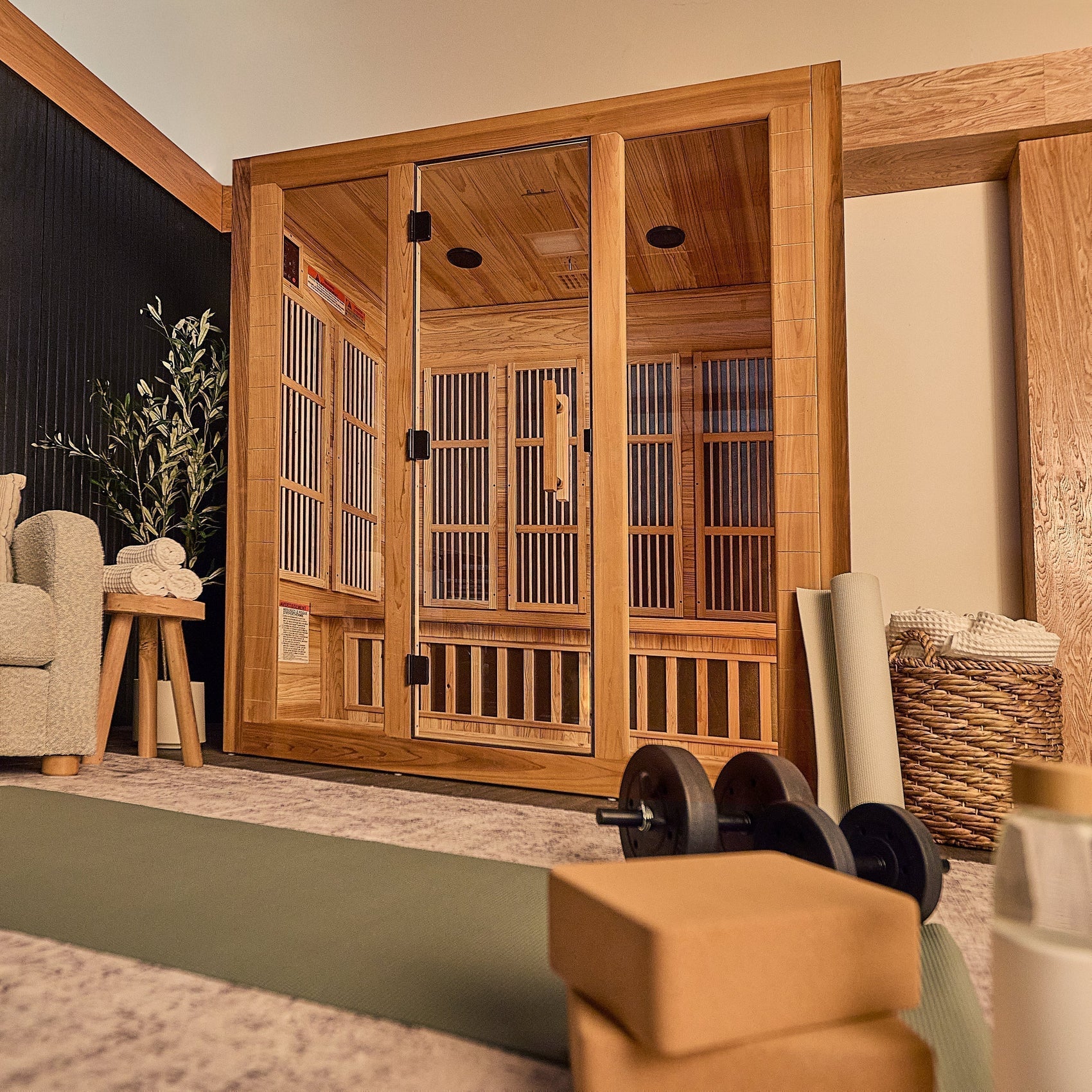
Infrared saunas are typically placed indoors, and models range from compact 1-person units up to 4-person saunas that seat a small group comfortably. Whether you use it solo after work or share it with your partner on a Sunday morning, the environment makes it easy to turn sauna use into a consistent daily habit rather than a special occasion.

Which Feels "Better"?
Neither. This is personal. If you crave intense heat, the ritual of steam, and the contrast of hot-then-cold, you'll probably prefer traditional. If you want a gentler, longer session that's easy to fit into a daily routine without much ceremony, infrared is likely your fit.
Sauna Installation: Electrical, Space, and Placement Requirements
Practical considerations often narrow the choice faster than preference does.
Infrared Sauna Installation
Most one- and two-person infrared saunas designed for home use run on a standard 120V household outlet on a dedicated 15-amp circuit. That means no electrician, no new wiring, and no additional installation costs beyond assembling the sauna itself. You plug it in and start. Backyard Discovery's infrared 1-person and 2-person saunas work exactly this way, and most homes already have a suitable outlet in a bedroom, basement, or garage.
Larger four-person infrared saunas need more power to drive their additional heating panels. Backyard Discovery's 4-person and 4-person corner Rylan saunas require a dedicated 240V/20-amp circuit installed by a licensed electrician. This is a straightforward job, similar to wiring a dryer outlet, and typically costs $300 to $800 depending on how far the circuit needs to run from your electrical panel. Schedule the electrical work before or during assembly so the sauna is ready to use the day you finish building it.
Indoor infrared saunas can be placed in spaces like a spare bedroom, basement, garage, or home gym. Backyard Discovery's infrared saunas ship with pre-built, pre-wired wall and ceiling panels that connect together during assembly, so the sauna itself requires no internal wiring on your end.
Energy costs are modest. A one- or two-person infrared sauna running three to four sessions per week typically adds $5–$10 per month to your electricity bill. Infrared saunas also tend to have a lower starting price point than traditional outdoor models, though the range varies by size and features. Browse Backyard Discovery's infrared collection for current pricing.
Traditional Sauna Installation
Traditional saunas need more from your space and your electrical system. Each Backyard Discovery traditional outdoor sauna comes with a PrairieFire™ electric sauna heater that requires a dedicated 240V circuit with a 50 amp breaker, hardwired by a licensed electrician. A standard installation typically costs $500 to $1,500. If your electrical panel is far from the sauna, requires trenching, or needs an upgrade, costs can range from $1,500 to $3,000. It's worth getting a quote from an electrician before purchasing so you understand the full cost upfront.
Outdoor placement is the most common choice for traditional saunas, both for practical reasons (ventilation, moisture, space) and for the experience. Stepping outside to your sauna is part of the ritual. Traditional saunas can also be placed indoors (in garages or basements) with proper ventilation and drainage planning, though outdoor installation remains the most common path. You'll need a level surface — a gravel pad, concrete, or pavers — along with enough clearance from your home and property lines per local code. Backyard Discovery's outdoor saunas ship as complete kits with the heater, stones, bucket and ladle, steel roof, glass door, and all hardware included, so you're not sourcing components separately after purchase. Assembly is guided through the BILT® app with 3D interactive instructions, and professional assembly is available if you'd rather leave the build to someone else.
Energy costs are higher than infrared because of the greater wattage, but still reasonable. Running a 9kW heater three to four times per week typically adds $15–$30 per month, depending on session length and local electricity rates.
Preheat time is the other practical difference. Traditional saunas take longer to reach temperature, which means you're planning sessions in advance rather than stepping in spontaneously. Backyard Discovery's traditional saunas include Wi-Fi remote start through a smartphone app, so you can begin preheating from your couch, your car, or your office. By the time you get home or finish dinner, the sauna is ready.
Infrared and Traditional Sauna Maintenance
All Backyard Discovery saunas are built with 100% aromatic cedar that's kiln dried to resist warping, cracking, and breakdown from repeated heat cycling. Cedar is naturally resistant to moisture, mildew, and decay, making it ideal for the high-heat, high-humidity environment inside a sauna. Because the interior cedar of our saunas is completely untreated, there are no chemicals off-gassing when the wood heats up. You also get that signature cedar aroma during every session, which for most people becomes part of the ritual.
That said, the two types require different levels of upkeep, largely because of where they're placed and whether steam and water are involved.
Infrared saunas are about as close to maintenance-free as a sauna gets. Wipe down the bench surfaces and glass door every few uses to manage sweat, and do an occasional deeper clean with a mild cleaner or a vinegar-and-water solution. Beyond that, there isn't much to think about. No steam means very low mold risk. No stones to inspect. No exterior exposed to weather. The heating panels have no consumable parts to replace. Cedar's natural resistance to moisture and mildew does most of the heavy lifting for you.
Traditional saunas need more regular attention, which comes with the territory of steam, water, and outdoor placement. Wipe down benches and the floor after use and make a habit of cracking the door to let the interior dry out thoroughly after every session. Good ventilation and consistent drying are the most important things you can do to prevent mold. Deep clean more frequently than you would an infrared sauna to stay ahead of odor buildup from repeated moisture exposure. Inspect and re-stack your sauna stones every few months. Over time they can crack or degrade from repeated heating, and most need replacing every 3 to 5 years depending on how often you use them. Because most traditional saunas sit outdoors, you'll also want to periodically seal or stain the exterior wood and check the door seals to keep the elements out. Cedar's natural decay resistance extends the life of both the interior and exterior, but outdoor exposure still calls for some care.
Neither type demands significant time or expense, but traditional saunas do require more upkeep.
One more cost factor that applies regardless of which type you choose: Backyard Discovery saunas are HSA and FSA eligible, which means you may be able to purchase with pre-tax health savings dollars, potentially saving 20–35% depending on your tax situation. Note that HSA/FSA sauna purchases require a Letter of Medical Necessity (LMN). Backyard Discovery has partnered with Truemed so you can apply for your LMN through the checkout process, and if approved, use your HSA or FSA funds directly. Visit Backyard Discovery's HSA/FSA page for details on how to submit.
Quick Comparison
Here's how traditional and infrared saunas compare across the factors that matter most when you're choosing.
| Feature | Traditional Sauna | Infrared Sauna |
|---|---|---|
| How it heats | Heats the air (and optional steam) | Heats your body directly via infrared panels |
| Operating temperature | 150–194°F (65–90°C) | 120–150°F (49–65°C) |
| Steam option | Yes — pour water over heated stones | No |
| Typical session length | 10–20 minutes | 30–45 minutes |
| Preheat time | 30–60 min (varies by heater output) | 20–40 minutes |
| Typical placement | Outdoors (barrel, cube, or cabin) | Indoors (bedroom, basement, home gym) |
| Electrical requirement | 240V dedicated circuit (hardwired) | 120V standard outlet with dedicated circuit (1–2 person) or 240V dedicated circuit (4 person) |
| Price range | ~$3,499–$4,999 | ~$1,999–$3,999 |
| Monthly energy cost | ~$15–$30 | ~$5–$10 |
| Maintenance | Stone inspection, bench/floor cleaning, exterior seal/stain, door seal checks, ventilation | Bench wipe-down, occasional deeper clean |
| Research depth | Extensive (decades of Finnish population studies) | Growing (promising clinical studies, smaller scale) |
| Best for | High-heat intensity, steam ritual, social/outdoor use | Gentle warmth, longer sessions, daily indoor routine |
Ready to compare specific models? Browse Backyard Discovery's infrared and traditional sauna collections with specs, pricing, and free shipping on every order.
How to Choose Between an Infrared and Traditional Sauna
Rather than ranking one type above the other, use these five questions to sort yourself into the right category.
1. Do you want steam? If the answer is yes — and the ritual of pouring water over stones and feeling that burst of humid heat is part of what draws you to saunas — traditional is the best option. Infrared saunas are dry heat only.
2. Where will it go? If you want an outdoor sauna experience as part of your backyard, traditional is the natural choice. Traditional barrel saunas, cube saunas, and cabin saunas are built for outdoor placement and the outdoor ritual. If you want it indoors in a spare room, basement, or corner of a home gym, infrared is the simpler path — though traditional saunas can also be installed indoors with proper ventilation and drainage planning.
3. How much heat can you handle? If you love intense heat and find it deeply satisfying, you'll gravitate toward traditional. If high temperatures feel uncomfortable or you have a health condition that makes extreme heat inadvisable (always consult your doctor), infrared's milder air temperature may be a better fit.
4. How important is quick, easy access? If you want to step in with almost no lead time, infrared's faster preheat and plug-and-play electrical setup means fewer barriers between you and your session. Traditional saunas take longer to reach temperature, though smart preheat controls can reduce the practical impact.
5. Is this a solo habit or a shared experience? Infrared saunas range from 1-person models built for solo use up to 4-person models that comfortably seat a small group. They work well for both daily personal sessions and sharing the space with a partner or friends. Traditional outdoor saunas come in 2–4 person and 4–6 person sizes, making them a natural fit for couples, families, or regular get-togethers with friends. If hosting people in your backyard sauna is part of the appeal, traditional gives you more room to work with — but infrared can absolutely be a shared experience too.
Whichever Type You Choose, Sauna Construction Quality Matters
The infrared-vs-traditional question gets the most attention, but it's not the only thing that determines whether you'll be happy with your sauna three years from now. Within each category, construction quality varies enormously.
For infrared saunas, look for thick, double-wall construction, a heavy tempered glass door that seals heat in, and enough heating panels positioned for full-body coverage rather than just warming one side of you. Panel count and placement are what separate a good infrared sauna from one that leaves you rotating on the bench trying to find the heat.
For traditional saunas, heater output relative to the room size is the single biggest performance factor. A heater that's too small takes forever to reach temperature and produces weak steam. Tongue-and-groove joinery, quality cedar construction, and a steel roof built for weather protection determine how well the sauna holds up and retains heat over years of use. A warranty that covers the heater's heating elements (not just the structure) tells you the manufacturer trusts their own product.

Backyard Discovery builds both types. Our infrared saunas are built with 8 to 11 low-EMF far-infrared carbon panels, with third-party testing showing readings below 0.4 mG at the seated position. Each one uses 33% thicker cedar in its double-wall construction and comes standard with a built-in red light therapy panel, chromotherapy lighting, and Bluetooth speakers. Our traditional outdoor saunas, available in barrel, cube, and cabin designs, are powered by a proprietary 9kW PrairieFire™ electric heater that reaches full temperature 50% faster than the 6kW heaters you'll find in most similarly priced models. Every kit ships complete with the sauna heater, Wi-Fi smart controls, stones, bucket, ladle, steel roof, and glass door. Both lines carry a 5-year comprehensive warranty that covers every component, including the parts that work hardest.
Both infrared and traditional saunas deliver real, documented wellness benefits. The right choice isn't about which type is objectively better — it's about which type fits the way you want to live. If the pull of intense heat, steam, and an outdoor ritual speaks to you, traditional is your sauna. If a gentler, longer session with radiant heat sounds more like your speed, infrared is the move. Use the five questions above to narrow it down, then look at the specific models that match your space, budget, and goals.
Shop Backyard Discovery's full sauna lineup. Every sauna kit ships complete with free delivery and our comprehensive 5-year warranty.
Traditional vs. Infrared Sauna: Frequently Asked Questions
Do infrared saunas produce steam?
No. Infrared saunas use dry radiant heat only; there are no stones and no water involved. If the steam ritual is important to you, a traditional sauna is the only option. Traditional saunas can run as dry heat or with steam, giving you both options in one unit.
How long should a sauna session last?
It depends on the type. Traditional sauna sessions typically run 10–20 minutes because the higher air temperatures (150–194°F / 65–90°C) are more intense. Infrared sessions run longer, usually 30–45 minutes, because the milder air temperature (120–150°F / 49–65°C) is easier to sustain. Start shorter and build up with either type. Stay hydrated and step out if you feel dizzy or lightheaded.
Are infrared saunas as effective as traditional saunas?
Both types raise your core temperature, increase heart rate, and trigger deep sweating — the mechanisms researchers believe drive most sauna health benefits. Traditional saunas have a much deeper research base, with decades of Finnish population studies linking regular use to cardiovascular benefits. Infrared research is newer and smaller in scale, but the published results are promising. Neither type is categorically "better" — they deliver similar core benefits through different experiences.
Which type of sauna is better for muscle recovery?
Infrared saunas are more commonly marketed for recovery, and the lower-temperature environment does make it easier to use a sauna immediately after exercise. As the body warms in an infrared session, circulation increases and muscles may relax, which is why many people build infrared sessions into their post-workout routine. Traditional saunas also support recovery through heat exposure and improved circulation, but the higher temperatures can feel like a lot right after intense training. Both work; infrared is typically the easier fit for a daily recovery habit.
Can you install a traditional sauna indoors?
Yes, though it requires more planning than an infrared sauna. Traditional saunas need proper ventilation, drainage for the steam/water, and a 240V hardwired electrical circuit. Most buyers place them outdoors for practical and experiential reasons, but garage and basement installations are possible with the right preparation. Infrared saunas are most commonly placed indoors with no special ventilation needed, though outdoor-rated infrared models are also available for buyers who want the backyard experience with infrared's gentler heat.
Are saunas safe during pregnancy?
Most medical guidelines advise pregnant women to avoid saunas, hot tubs, and other prolonged heat exposure due to the risk of elevated core body temperature. This applies to both infrared and traditional saunas. Consult your OB-GYN before using any type of sauna during pregnancy.
References
- Laukkanen JA, Khan H, Zaccardi F, Laukkanen T. Association between sauna bathing and fatal cardiovascular and all-cause mortality events. JAMA Internal Medicine. 2015;175(4):542–548. doi: 10.1001/jamainternmed.2014.8187
- Laukkanen JA, Laukkanen T, Kunutsor SK. Cardiovascular and other health benefits of sauna bathing: a review of the evidence. Mayo Clinic Proceedings. 2018;93(8):1111–1121. doi: 10.1016/j.mayocp.2018.04.008
- Imamura M, Biro S, Kihara T, et al. Repeated thermal therapy improves impaired vascular endothelial function in patients with coronary risk factors. Journal of the American College of Cardiology. 2001;38(4):1083–1088. doi: 10.1016/S0735-1097(01)01467-X
- Miyamoto H, Kai H, Nakaura H, et al. Safety and efficacy of repeated sauna bathing in patients with chronic systolic heart failure: a preliminary report. Journal of Cardiac Failure. 2005;11(6):432–436. doi: 10.1016/j.cardfail.2005.03.004

Leave a comment
This site is protected by hCaptcha and the hCaptcha Privacy Policy and Terms of Service apply.