


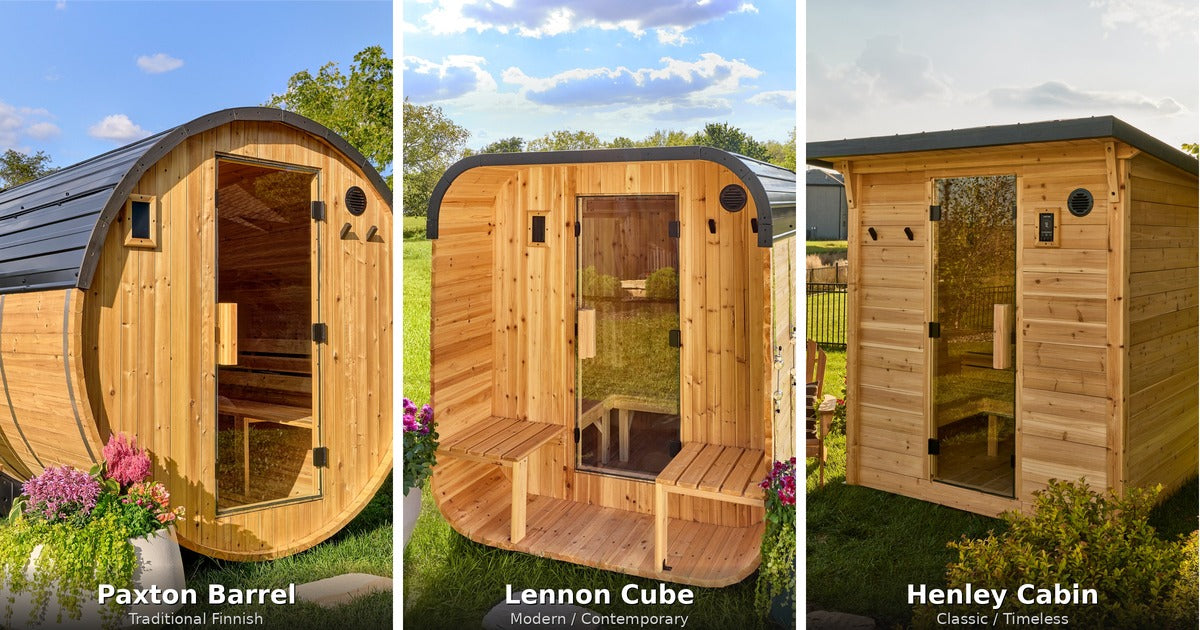
If you've been browsing outdoor saunas, you've probably noticed three distinct shapes: the classic rounded barrel, the contemporary cube, and the traditional cabin. They look different, they're priced in similar ranges, and the marketing for each one makes it sound like the obvious choice.
Each shape handles heat differently, uses interior space differently, and fits into a backyard differently. We build all three (the Paxton Barrel, the Lennon Cube, and the Henley and Bennett Cabins) because we think the shape should match your preference, not be limited by what a brand happens to sell.
This guide breaks down the real differences across five factors that affect your daily backyard sauna experience: heat distribution, interior space and bench layout, exterior footprint, aesthetics, and weather durability. We'll use our own collections to show the specifics, because vague comparisons don't help when you're spending $3,499 to $4,999 on something you'll use for years.
If you're still deciding between an infrared sauna or a traditional outdoor sauna, start with our full comparison guide.
What Is the Best Shape for an Outdoor Sauna?
There is no single best shape. Barrel saunas heat efficiently with natural convection and seat everyone at the same heat level on linear benches. Cube saunas provide modern aesthetics with the most compact footprint and versatile bench layouts including L-shaped and stacked options. Cabin saunas offer timeless design with traditional two-level bench seating. The right backyard sauna shape depends on your space, design preference, and how you want to sit.
What Every Outdoor Sauna Shape Includes
Before comparing what's different, it helps to understand what's identical across all three shapes. Every Backyard Discovery outdoor sauna, whether barrel, cube, or cabin, is built with the same core components and construction standards.
PrairieFire™ 9kW electric heater. We designed our proprietary 9kW heater to deliver consistent performance across every shape and size in the lineup. From the compact 2–4 person interiors to the larger 4–6 person models, it reaches full temperature up to 50% faster than the 6kW heaters you'll find in most similarly priced models. It's constructed from heavy-duty 430-grade stainless steel, ETL listed for North American safety standards, and ships complete with stones, a bucket, and a ladle. Actual heat-up time will vary by interior volume — the 2–4 person models reach temperature faster than the 4–6 person models, as you'd expect — but the heater itself never changes. All three collections require a 240V/50A dedicated circuit installed by a licensed electrician. Budget $500–$1,500 for a standard installation so you have the full cost picture before purchasing.
100% aromatic cedar construction. Built entirely from kiln-dried aromatic cedar with tongue-and-groove construction for the walls. No filler woods, no mixed materials. The natural aromatic oils in the cedar resist rot, decay, and insects while the interlocking wall joinery creates a tight, draft-free shell. The interior is completely chemical-free, built entirely from natural cedar with no glues, adhesives, or synthetic materials, so when the sauna heats up there is nothing to off-gas into the air you're breathing.
Everything included, nothing upsold. Wi-Fi remote start with a smartphone app, dimmable LED interior lighting, a built-in thermometer and hygrometer, two powder-coated robe hooks, an 8mm tempered glass door, a 29-gauge galvanized steel roof, and step-by-step 3D assembly guidance through the BILT® app all come standard. Professional assembly is also available if you'd rather leave the build to someone else.
5-year comprehensive warranty. Covers every component: the heater, the heating elements, the cedar, the hardware, the glass, the steel roof. No exclusions and no gaps.
With the foundation the same across the board, the differences between shapes are genuinely about the shape itself: how heat moves inside it, how the benches are configured, and how it sits in your yard.
Outdoor Sauna Heat Distribution: How Shape Affects Performance
The shape of a sauna isn't just decorative. It directly changes how heat moves through the interior. The PrairieFire™ sauna heater provides the same 9kW output in every model, but the walls, ceiling, and geometry determine how that heat reaches you.

Barrel Sauna: Natural Convection Heat
Barrel saunas like the Paxton use their curved walls to create a natural convection effect. Hot air rises from the heater, spreads across the rounded ceiling, and circulates back down along the curved surfaces, keeping the air in motion rather than stratifying into distinct temperature layers. The continuous curve means the sauna heats quickly and the warmth feels enveloping from the moment you sit down.
The trade-off is ceiling height. The highest point is at the center of the curve, and the ceiling slopes down toward the edges where you're sitting. The hottest air concentrates at the very top, above your head if you're sitting in the center, with the temperature dropping a few degrees as you move toward the sides. The air is moving, but the usable hot zone is concentrated in a narrower band than in flat-ceiling designs. In practice, most people don't notice the variation once they're settled in. But if you want the ability to choose between distinct heat levels within the same session, the flat-ceiling shapes give you that option.
Cube Sauna: Even, Layered Heat
Cube saunas like the Lennon, sometimes called a square sauna for its boxy proportions, use a flat ceiling and vertical walls to create a more uniform temperature gradient from floor to ceiling. Hot air rises and spreads across the entire flat ceiling more evenly, producing clearly defined heat layers: hotter near the ceiling, milder near the floor, with a predictable and consistent transition between the two. The Lennon's signature rounded corners soften the geometry and give the space a contemporary, finished feel compared to the hard angles of a traditional cabin sauna.
In the 4–6 person Lennon, this layered heat matters even more because of the stacked bench layout. You can sit on the upper bench for more intense heat or move to the lower bench for a milder session, and the difference between the two is reliable. The flat ceiling distributes the hottest air over a wider area, so you're not losing heat to a narrow peak.
Cabin Sauna: Layered Heat
Cabin saunas like the Henley and the Bennett share the flat walls and traditional ceiling of the cube, so heat behavior is similar. Hot air rises, creating a clear temperature difference between the upper and lower parts of the space. The sloped roofline adds a small amount of vertical space at the top, giving the hottest air slightly more room to collect before reaching the bench area. The practical effect is subtle: the air near the ceiling may run a few degrees warmer than in the Lennon, but the temperature at sitting height is comparable.
Where the Henley's design really comes through is in how the classic rectangular proportions and sloped roof create a home sauna that feels like it was always part of your backyard. The heat experience is excellent, and the ambiance amplifies it.
Sauna Bench Layout Comparison: Linear, L-Shaped, and Stacked
This is one of the areas where the three shapes diverge, and where the choice often gets made. Two saunas rated for the same number of people can feel very different inside depending on how the bench configuration works with the walls and ceiling.

Barrel Sauna Benches: Linear Seating
The Paxton uses two linear benches along both walls in both the 2–4 person and 4–6 person sizes. This puts everyone at the same height and roughly the same distance from the heater. Nobody gets the "hot seat," and nobody is stuck in a cooler spot.
It's a layout that works especially well for couples or friends who want to sit together at the same heat level and carry on a conversation face to face. The Paxton feels intimate and cozy. For people drawn to the classic Finnish sauna experience, this is the interior that delivers it.
The curved ceiling does limit how you can position yourself. Taller users may notice the slope at the edges and lying fully flat means your head and feet move into slightly cooler zones. For sitting upright and socializing, the Paxton is excellent.
Cube Sauna Benches: L-Shaped and Stacked
The Lennon's bench layout changes with the size you choose. The 2–4 person Lennon features an L-shaped bench that wraps around a corner of the interior — 87 inches of total bench length at 21 to 24 inches deep depending on the section. Everyone sits at the same height, similar to the Paxton, but the L-shape creates a natural corner seat that works well for reclining, and the open floor area makes the interior feel bigger than its footprint suggests.
The 4–6 person Lennon steps up to stacked two-level benches. The upper bench runs hotter because heat rises, while the lower bench stays milder, so you can choose your intensity within the same session or accommodate different preferences when you're sharing the space.
The interior of the Lennon feels open and spacious. The rounded corners soften the design without losing any of the usable space, and the modern proportions give the sauna a contemporary, architectural quality from the inside as well as the outside.
Cabin Sauna Benches: Two-Level Layout
The Henley offers stacked two-level bench seating in both the 2–4 person and 4–6 person sizes, and the Bennett offers the same layout in a single 2–4 person size. Upper bench for intensity, lower bench for a milder experience.
The cabin's stacked layout works naturally with heat distribution. In the 4–6 person Henley, there's room for multiple people on each level, so a group can spread out comfortably rather than clustering on a single bench. For solo sessions, you have the full upper bench to stretch out on, with the lower bench serving as a step or a cooler resting position between rounds.
If you've ever used a sauna at a resort or gym and thought "I want that experience at home," the cabins deliver the closest match. Stacked two-level benches inside flat walls and rectangular proportions: it's the room most commercial saunas use, scaled for a backyard.
Outdoor Sauna Size: How Each Shape Fits Your Backyard
How a sauna sits in your backyard matters as much as how it feels inside. Each shape occupies space differently. Here are the exterior dimensions, interior volumes, and bench measurements across every model and size so you can measure your space before committing.
| Model | Size | Exterior (W×D×H) | Interior Vol. | Porch | Bench Layout |
|---|---|---|---|---|---|
| Paxton Barrel | 2–4P | 76″ × 65.6″ × 80″ | 154 cu ft | No | 2 linear benches (57″ × 19″) |
| Paxton Barrel | 2–4P (porch) | 76″ × 83.5″ × 80″ | 154 cu ft* | Yes | 2 linear benches (57″ × 19″) |
| Paxton Barrel | 4–6P | 76″ × 83.5″ × 80″ | 201.5 cu ft | No | 2 linear benches (75″ × 19″) |
| Paxton Barrel | 4–6P (porch) | 76″ × 101.5″ × 80″ | 201.5 cu ft* | Yes | 2 linear benches (75″ × 19″) |
| Lennon Cube | 2–4P | 69.5″ × 53.1″ × 78.3″ | 124 cu ft | No | 1 L-shaped bench (87″, 21″/24″ depth) |
| Lennon Cube | 2–4P (porch) | 69.5″ × 71″ × 78.3″ | 124 cu ft* | Yes | 1 L-shaped bench (87″, 21″/24″ depth) |
| Lennon Cube | 4–6P | 69.5″ × 76.2″ × 78.3″ | 187.8 cu ft | No | 2 stacked benches (65.5″ × 24″) |
| Lennon Cube | 4–6P (porch) | 69.5″ × 94″ × 78.3″ | 187.8 cu ft* | Yes | 2 stacked benches (65.5″ × 24″) |
|
Henley/ Bennett Cabin |
2–4P | 62.3″ × 90.8″ × 81.5″† | 130.5 cu ft | No | 2 stacked benches (50″ × 20″) |
| Henley Cabin | 4–6P | 80″ × 90.8″ × 81.5″† | 170.6 cu ft | No | 2 stacked benches (65″ × 20″) |
*Interior volume is the same with or without porch; the porch adds exterior depth only. †Henley/Bennett exterior dimensions include roof overhang; the ground footprint is smaller than the listed depth.
Barrel Sauna Footprint
Barrel saunas sit wider than cabin or cube designs, but the real footprint consideration is depth. The Paxton extends further front-to-back than its width suggests, especially the porch versions. That overall footprint makes it a natural fit for spacious backyards where the length has room to breathe.
The Paxton is available with or without a covered porch, which adds a built-in transition zone for cooling down but increases the total depth. If you're working with a tighter yard, measure the full footprint before committing, not just the barrel diameter. See the full Barrel collection →

Cube Sauna Footprint
Cube saunas like the Lennon occupy a squarish footprint that's predictable to plan for and easy to integrate into a patio, deck, or defined outdoor living area. The clean geometry aligns naturally with other modern structures like pergolas, decks, and pool fences, which makes it the easiest shape to fit into a designed outdoor space.
Like the Paxton, the Lennon is available with or without a covered porch. The porch version extends the footprint but adds that same practical transition zone at the entrance, plus a bit more privacy. See the full Cube collection →
Cabin Sauna Footprint
Cabin saunas tend to have the most familiar architectural footprint. It looks like a small building, which makes it easy to place alongside your home, a pool house, or other backyard structures. The sloped roofline gives the sauna a settled, permanent presence that most homeowners associations and neighbors find unobtrusive.
The footprint is rectangular and slightly larger than the cube at equivalent capacity. Our cabins are designed without a porch, keeping the overall footprint compact and giving you flexibility to create your own transition space with outdoor seating, a stone pathway, or whatever fits your space. See the full Cabin collection →
Outdoor Sauna Aesthetics: Barrel, Cube, and Cabin Design Compared
You're going to look at this sauna every day and show it to everyone who comes over. How it looks in your yard matters.
Paxton Barrel: Iconic Finnish Design
The barrel silhouette is immediately recognizable as a sauna. The Paxton makes a statement; it reads as intentional, like you chose it specifically because you wanted the authentic Finnish look. Outdoor barrel saunas work particularly well in natural settings with trees, stone, and organic landscaping. If your backyard has a cabin-in-the-woods feel, the Paxton looks like it grew there.
Lennon Cube: Contemporary and Architectural
The Lennon is the most modern of the three. The clean lines, rounded corners, and minimal design complement contemporary architecture, modern decks, and streamlined outdoor furniture. If your backyard has a designed, intentional feel (concrete planters, a built-in grill, a minimalist patio), the Lennon looks like it belongs there. It's the shape most likely to draw compliments from the design-savvy.
Henley & Bennett Cabin: Timeless and Versatile
The Henley is the most versatile aesthetically. Its traditional proportions and sloped roofline don't commit you to a specific design language. A cabin sauna looks appropriate in a modern yard, a rustic yard, and everything in between. It's the most conservative choice visually, which also makes it the safest one if you're thinking about resale value or design compatibility. A cabin sauna never looks out of place. If you like the cabin proportions but want a darker, modern edge, the Bennett pairs the same silhouette with black trim and a smoke-tinted glass door.

Sauna Weather Durability: Year-Round Outdoor Performance
All Backyard Discovery traditional sauna collections are built for year-round outdoor use with the same weather-ready materials: 29-gauge powder-coated galvanized steel roofing, kiln-dried aromatic cedar, tongue-and-groove joinery, and 8mm tempered glass doors.
Barrel Sauna Weather Performance
The Paxton's curved roof is naturally self-draining. Rain and snowmelt run off without pooling, and in heavy snow climates the curve sheds accumulation cleanly. The powder-coated galvanized steel roof wraps over the curve for full coverage.
Barrel saunas use tension bands and support cradles to hold the curved staves together. Over time, as wood naturally expands and contracts with seasonal changes, those bands may need occasional tightening. Quality kiln-dried cedar minimizes movement, but periodic tension band checks are part of barrel sauna ownership.
Cube Sauna Weather Performance
The Lennon's roof uses the same powder-coated galvanized steel construction as the Paxton, Bennett, and Henley. It's installed with a very slight slope (about 1-2 degrees) to help rainwater run off and prevent pooling.
Like the Paxton, the Lennon uses tension bands and support cradles as part of its construction. The same seasonal wood movement applies, so the bands will need the same periodic checks and occasional tightening. The flat walls and rounded corners create a rigid shell, and the tongue-and-groove joinery handles expansion and contraction well between adjustments.
Cabin Sauna Weather Performance
The Henley and Bennett's sloped roof sheds rain and snow efficiently, with a pitch that moves water and accumulation off the surface without pooling or buildup.
Unlike the barrel and cube, the cabin does not use tension bands. Its tongue-and-groove panel construction is secured with ground anchors, creating a rigid, self-supporting shell without any bands to tighten. This makes the cabins the lowest-maintenance shape from a structural perspective. Like any outdoor wood structure, all three shapes benefit from periodic cleaning of the cedar surfaces, glass door care, and heater stone inspection, but the Henley and Bennett are the only ones that don't require tension band maintenance.
Barrel vs. Cube vs. Cabin Sauna: Side-by-Side Comparison
| Feature | Paxton Barrel | Lennon Cube | Henley Cabin |
|---|---|---|---|
| Style | Traditional Finnish | Modern / Contemporary | Classic / Timeless |
| Sizes | 2–4P / 4–6P | 2–4P / 4–6P | 2–4P / 4–6P |
| Bench Layout | Two linear (both sizes) | L-shaped (2–4P) / Stacked two-level (4–6P) | Stacked two-level (both sizes) |
| Porch Option | Yes | Yes | No |
| Heat Circulation | Natural convection; cozy, even warmth | Even distribution; defined heat layers on stacked benches | Even distribution; defined heat layers on stacked benches |
| Construction | Tongue-and-groove cedar + tension bands + support cradles | Tongue-and-groove cedar + tension bands + support cradles | Tongue-and-groove cedar + ground anchors |
| Best Fit | Natural settings; larger yards; same-heat-level socializing | Modern architecture; compact footprint; design-conscious spaces | Any landscape style; classic interior; resale-friendly |
| Starting Price | $3,499 | $3,499 | $3,999 |
| Heater | PrairieFire™ 9kW | PrairieFire™ 9kW | PrairieFire™ 9kW |
| Warranty | 5-Year Comprehensive | 5-Year Comprehensive | 5-Year Comprehensive |
Prices current as of March 2026. See each collection page for live pricing.
The Bennett cabin (2–4 person, black trim, smoke-tinted glass) shares the Henley's cabin construction. See the Bennett product page for current pricing.
Backyard Discovery outdoor saunas may qualify as HSA/FSA purchases with a Letter of Medical Necessity from your healthcare provider. Visit our HSA/FSA page for details.
So Which Sauna Should You Choose?
There's no formula here. But there are clear signals that point toward each shape based on how you plan to use the sauna and what matters most in your space.
Choose the Paxton Barrel if you want the traditional Finnish aesthetic, efficient heat from the curved shape, and a side-by-side bench layout that keeps everyone at the same temperature. The Paxton is a natural fit for wooded or organic-feeling backyards and for couples or friends who want the classic communal sauna experience. Available in 2–4 and 4–6 person sizes, with or without a covered porch.
Choose the Lennon Cube if you're looking for a modern design, the most compact footprint for smaller spaces, and versatile bench options (L-shaped for the 2–4 person, stacked two-level for the 4–6 person). The Lennon makes sense for people who value interior flexibility and an architectural look that complements a designed patio or deck. Available in 2–4 and 4–6 person sizes, with or without a covered porch.
Choose the Henley Cabin if you want a timeless look that blends into any landscape, a stacked two-level bench layout in every size for that traditional spa feel, and a structure that looks like a permanent, intentional part of your property. The Henley is also the lowest-maintenance option with no tension bands to tighten, and the most versatile aesthetic choice regardless of your home's style. Available in 2–4 and 4–6 person sizes. Prefer the cabin look with a striking, modern edge? The Bennett offers the same shell and two-tier layout with black trim and smoke-tinted glass in a 2–4 person size.
Whichever shape fits your yard and your style, the heat, the cedar, the heater, and the accessories are the same across every model. The shape is yours to choose.
Outdoor Sauna Shape: Frequently Asked Questions
Are barrel saunas better than cabin or cube saunas?
No single shape is objectively better. Barrel saunas like the Paxton heat efficiently thanks to their curved walls and have a compact footprint, but they offer a fixed side-by-side bench layout. Cube saunas like the Lennon and cabin saunas like the Henley provide more bench configuration options, including stacked two-level seating that lets you choose your heat intensity. The best shape is the one that fits your backyard, your aesthetic preference, and how you want to sit.
Do barrel saunas have uneven heat?
Barrel saunas circulate heat well due to their curved walls, but the curved ceiling does create a few degrees of temperature variation between the center (hottest) and the side seating positions (slightly cooler). For most barrel sauna owners, the difference is subtle. Cube and cabin saunas, with their flat ceilings, distribute heat more evenly across the full width of the interior, which becomes especially noticeable with stacked bench layouts.
Is a barrel sauna or cabin sauna better for a small backyard?
It depends on your yard's shape and layout. Barrel saunas are narrow in width but extend further front-to-back, especially with a porch. The Paxton 2–4P without a porch is 76″ wide by about 66″ deep, while the Lennon 2–4P is roughly 69.5″ by 53″, making it the most compact option overall. The Henley is deeper at about 91″ but narrower at 62″ in the 2–4P size. Check the dimensions table above and measure your space before committing.
Which outdoor sauna shape has the most flexible seating?
It depends on how you want to sit. The Paxton barrel's side-by-side benches keep everyone at the same heat level, which is great for socializing. The Lennon cube's L-shaped benches (2–4P) offer a relaxed, flexible seating arrangement, and the stacked benches (4–6P) give you upper and lower heat options. The Henley cabin delivers stacked two-level seating in both sizes. None is better; they're designed for different preferences.
Do different sauna shapes need different heaters?
Not with Backyard Discovery saunas. We use the same proprietary PrairieFire™ 9kW electric heater across every outdoor sauna in our line — Paxton barrel, Lennon cube, and Henley/Bennett cabin — because we specifically chose a 9kW output to perform well across every interior volume without requiring upgrades. A smaller heater would mean different models need different power levels. Ours doesn't. It's our own design, ETL listed, constructed from heavy-duty 430-grade stainless steel, and comes complete with stones, a bucket, and a ladle. All three shapes require the same 240V/50A dedicated circuit.
Can I use an outdoor sauna in winter?
Yes, winter is one of the best times to enjoy a sauna. All of our traditional collections are built for year-round outdoor use with kiln-dried aromatic cedar, galvanized steel roofing, and 8mm tempered glass doors. Our 9kW PrairieFire™ electric heater is built for cold weather. Preheat times can run longer when temperatures drop, and in extreme conditions combined with high winds, the interior may stay a few degrees below peak temperature. Every model includes a Wi-Fi-enabled control panel, so you can start preheating from inside the house and walk out to a sauna that's already at your desired temperature.

Leave a comment
This site is protected by hCaptcha and the hCaptcha Privacy Policy and Terms of Service apply.